Trade press editorial calendars: how to use the topic plans of trade media
“We just don’t have any topics for the trade press.” We hear that a lot. It’s rarely true. The topics are there. They just come at the wrong time. Editors publish the right time themselves, often a year in advance.
Contents
- What is an editorial calendar in the trade press?
- Where do you find the editorial calendars of trade media?
- How do you read an editorial calendar properly?
- How much lead time does each format need?
- How do you turn many editorial calendars into your own annual plan?
- What do you do if your topic isn’t in any calendar?
- Do you need to buy an ad to appear in a focus issue?
- When does it pay to hand over the planning?
- Frequently asked questions
Key points at a glance
- An editorial calendar shows the focus topic and the key dates for every issue of a trade journal.
- Most trade media publish it in autumn with their media kit, covering the whole following year.
- For press work, the editorial deadline is what counts. Your offer should reach the editors weeks before it.
- Case studies need the longest lead time, because the interview and the customer’s approval take time.
- Five to eight calendars of your most important titles add up to your own annual plan with fixed dates.
- An ad doesn’t buy space in the editorial section. Reputable trade media keep the two apart.
What is an editorial calendar in the trade press?
An editorial calendar in the trade press is a trade journal’s overview of the year: it lists the focus topic, the publication date and the editorial deadline for each issue, and often the trade fairs the issue comes out for. In German it’s called a Themenplan or Redaktionsplan. Some publishers call it a topic preview. It’s the same thing.
For your B2B press work, it’s the most important sheet of paper of the year. It tells you when an editorial team is looking for exactly the topic you want to offer. If you know it, you offer at the right time. If you don’t, you’re lucky or you aren’t.
Here’s what such a plan looks like: an intralogistics trade journal announces order picking systems as the focus of its March issue, together with the LogiMAT preview. May is about industrial trucks, September about warehouse software. Next to each issue are the dates, from the editorial deadline to the ad deadline. That’s all you need to plan.
Where do you find the editorial calendars of trade media?
The editorial calendars of trade media are almost always in the publisher’s media kit, which you can download from the title’s website. In Germany, look for “Mediadaten” or “Mediaservice”. Sometimes the section is called “Werben”. LOGISTIK HEUTE is one example. It provides its media kit in its Mediaservice section.
Sounds obvious? It is. Still, many people never look, because media kits are made for advertisers. Ad rates and formats don’t matter to you. The editorial calendar is usually a section of a few pages.
A few things help with the search:
- New media kits usually come out in autumn for the following year. If you plan in January, you’ll find almost everything online already.
- Many publishers produce special issues and supplements alongside the regular journal, for trade fairs for example. They often have their own plans.
- Some titles also plan topic weeks on their website or in their newsletter. That isn’t always in the PDF. A short question to the editors helps here.
- If the plan is missing, call or drop a line. Editors are happy to share it. After all, they want relevant material.
How do you read an editorial calendar properly?
You read an editorial calendar properly if you look at the focus topic and the editorial deadline of each issue first. Then comes the trade fair the issue is published for. Everything else is detail. And these are exactly the places where most mistakes happen.
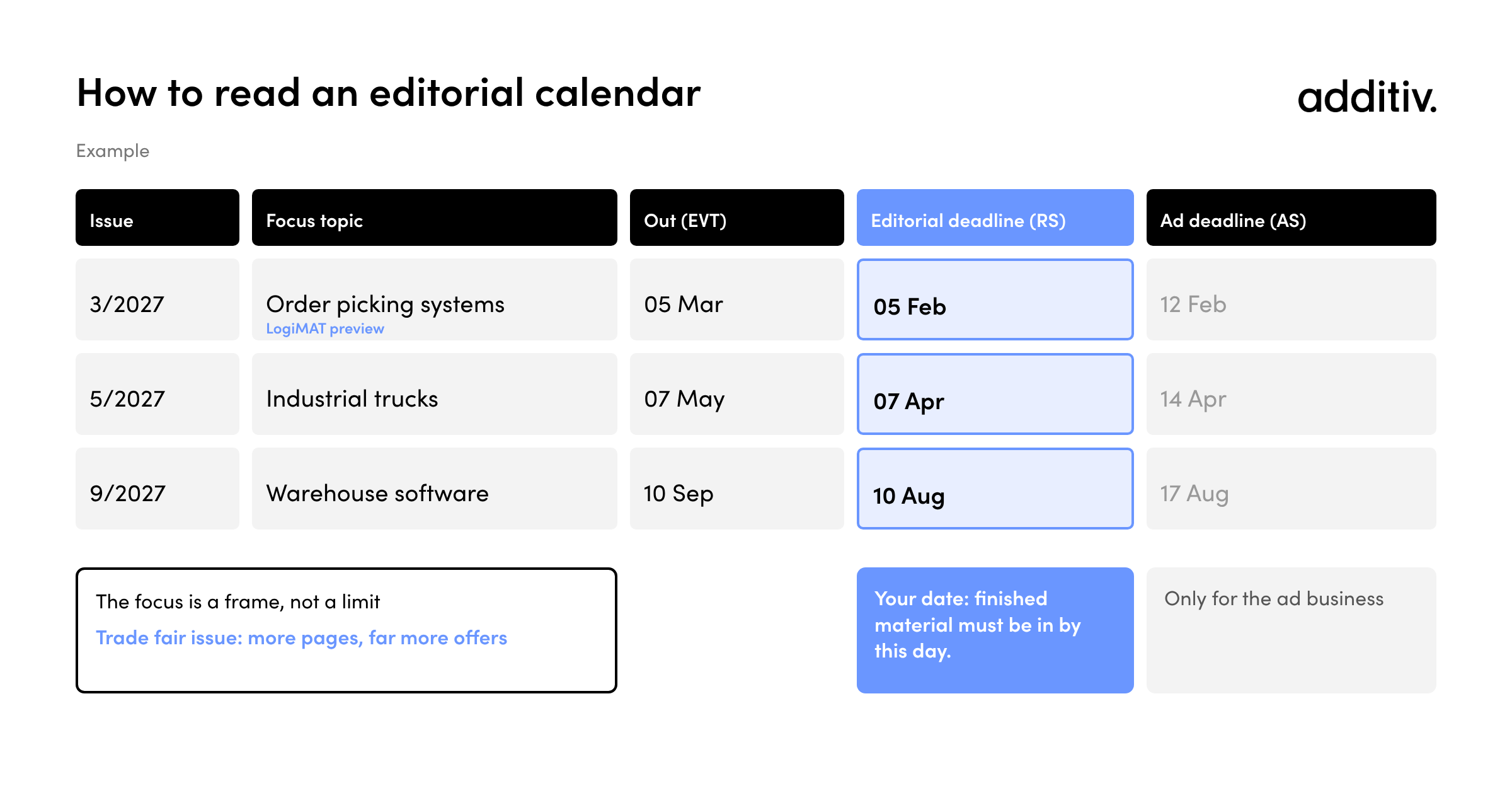
The editorial deadline is your date. Many plans also list the ad deadline. It’s often later. For your case study it doesn’t matter. And even the editorial deadline is only the last date for finished material. A new idea has to reach the editors much earlier.
The focus topic is a frame. If the plan says “conveyor technology”, the editors have extra space for it. Other topics still make it into the issue. Ask yourself: where does my topic touch this focus? A charging system for industrial trucks also fits an issue on energy efficiency in the warehouse.
Trade fair issues are crowded. Before LogiMAT or Hannover Messe, everyone wants to be in. The fair issue has more pages, but also far more offers. The issue after often brings more, because that’s where the follow-up reports appear.
Market overviews have their own deadlines. Many trade media print tables comparing suppliers, for driverless transport systems or stacker cranes for example. The questionnaires go out weeks before the editorial deadline. If you’re not on the editors’ list, you’re often missing from the table. Ask for the questionnaire in good time.
The abbreviations are quickly learned. German plans often use codes such as EVT for the day the issue comes out. RS usually means the editorial deadline. AS and DU often stand for the ad deadline and print material. Both belong to the ad business. For press work, you only need RS and EVT.
Plans change. Publishers move focus topics or add special topics at short notice. Sometimes an editorial deadline moves too. So check the current version again before every offer, or ask briefly.
How much lead time does each format need?
How much lead time you need depends on the format: a case study needs the most, a news item on the focus topic the least. Always count backwards from the editorial deadline. That shows you when you have to start.
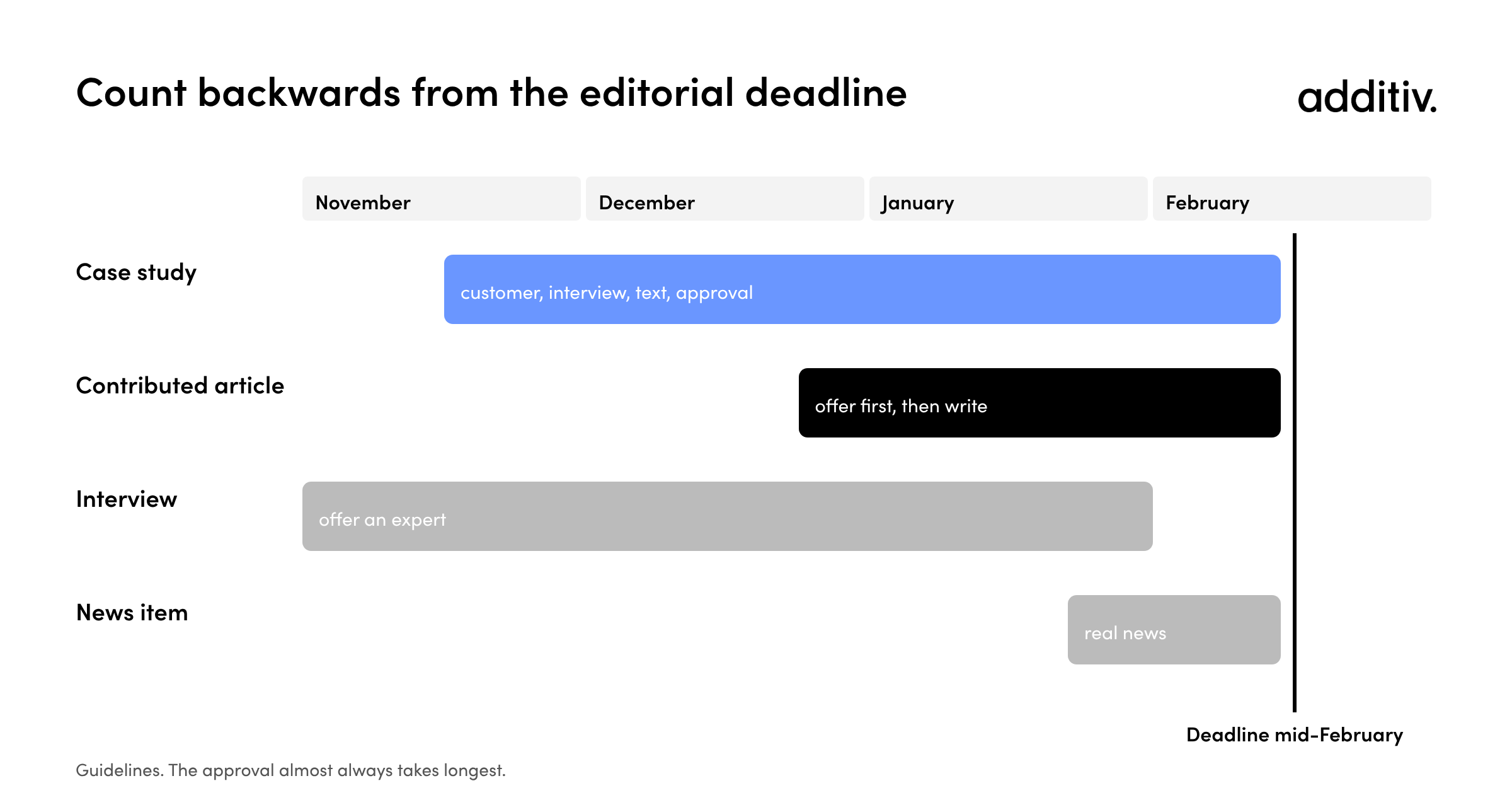
Imagine the editorial deadline for the focus issue is mid-February. Then the way back looks roughly like this:
- Case study: agree the topic with the customer, find a date for the interview, write the text, get the customer’s approval. This often takes two to three months. So start by mid-November at the latest.
- Contributed article: first offer the topic to the editors, then write. The offer should reach them six to eight weeks before the editorial deadline.
- Interview or expert voice: editors plan their interviews early. Offer an expert as soon as the plan is out.
- News item on the focus topic: real news fits until shortly before the editorial deadline. Ideally with a note that it belongs to the focus.
These figures are guidelines. The approval almost always takes longest. Plan generously for it, especially if the customer’s legal department reads along.
How do you turn many editorial calendars into your own annual plan?
Many editorial calendars become your own annual plan when you lay your topics against the focus topics of your most important titles and note a date for every match. That sounds like hard work. It’s one afternoon in December that pays off all year.
Here’s how:
- Pick five to eight titles. Take the trade media that the decision-makers in your target group read. Titles that only sort of fit aren’t relevant for your plan.
- Write down your topics for the year. That includes product launches and planned case studies. Technical questions your experts have something to say about count too.
- Put both side by side. You don’t need software for this. A spreadsheet will do. Months across the top, titles down the side. The focus topics go into the cells. Mark where one of your topics fits.
- Enter the dates. For every match, note the editorial deadline. Counting backwards gives you the day you make your offer.
- Spread the load. If five matches fall in March, take the best two. Move the others to a later focus or turn them into a contributed article that isn’t tied to an issue.
There’s a side effect many underestimate. With this plan, you have an answer when management asks what press work will deliver next year. You don’t show intentions, you show dates in specific media.
What do you do if your topic isn’t in any calendar?
If your topic isn’t in any editorial calendar, that’s no reason to drop it. The calendar only shows where the editors have extra space. Every issue also has pages for news and practical reports.
Sound familiar? Your topic is too new or too specialised for any focus. Then three routes help:
- Turn the angle. If “warehouse planning software” isn’t anywhere, maybe “digitalisation” or “planning and construction” is. Tell your story from that direction.
- Go online. Online editors are less tied to issues. A good contributed article almost always fits there.
- Ask the editors. A short call clarifies whether a topic can find space outside the plan. Often this leads to an article nobody had thought of.
And when real news comes up, send it straight away. How to offer a topic is covered in our article on pitching a topic to the trade press.
Do you need to buy an ad to appear in a focus issue?
No, you don’t need an ad for an editorial article in a focus issue. The editorial calendar sits in the media kit, which is aimed at advertisers. The editors still choose the articles.
In Germany, the press code of the German Press Council (Pressekodex, section 7) requires a clear separation between editorial text and publications for advertising purposes. Reputable trade media stick to it. Paid formats such as advertorials or sponsored publications exist. But they must be recognisable as advertising. And they don’t replace an editorial article.
Can an ad still make sense? Yes, as a separate decision for visibility in the right environment. It doesn’t work as a ticket into the editorial office. Anyone who books with that expectation will be disappointed. And the editors notice.
When does it pay to hand over the planning?
Handing over the planning pays off once good topics keep missing a focus issue. As long as you know the titles in your industry and have fixed time for the editors every week, you can plan yourself. Reading the plans is quick. The work comes afterwards: offering topics on time, agreeing case studies with customers, meeting deadlines, following up.
A second signal: the editors don’t know you yet. You don’t know whom to call. Then you need someone who reads the plans of the key titles every year anyway and knows the people behind them.
That’s exactly what we do in our press relations for B2B companies. For our work for the Open Logistics Foundation, we won the Deutscher Agenturpreis 2026 (German Agency Award) in the category “B2B / Pressearbeit” (B2B press relations).
Frequently asked questions
When do trade journals publish their editorial calendars for the next year?
Most trade journals publish their editorial calendars in autumn with their new media kits. If you search from October, you’ll usually find the plans for the following year on the publisher’s website.
What’s the difference between the editorial deadline and the ad deadline?
The editorial deadline is the last date for editorial material. The ad deadline only applies to ads. For press work, only the editorial deadline counts. A topic offer should reach the editors well before it.
How early should I offer a case study for a focus issue?
You offer a case study to the editors as soon as the customer has agreed, as a guideline two to three months before the editorial deadline. The interview with the customer and above all the approval take time.
Do I have to stick to the editorial calendar?
No, you don’t have to stick to the editorial calendar. It shows where editors have extra space for a topic. Current news and good practical reports also have a chance outside the focus topics, especially online.
Can I ask the editors for a trade journal’s editorial calendar?
Yes, you can ask the editors for a trade journal’s editorial calendar. If it isn’t in the media kit, the editors or the ad sales team usually send it on a short request. Editors have an interest in getting relevant material.
Does an ad help to get mentioned editorially in a focus issue?
No, an ad doesn’t help you get mentioned editorially in a focus issue. Reputable trade media separate ads from the editorial section, as section 7 of the German press code requires. The editors decide on editorial articles based on what’s useful to their readers.
How many trade journals should I include in my annual plan?
For most industrial companies, five to eight titles whose readers match their own target group are enough. More titles mean more deadlines, but rarely more relevant coverage.
