Press releases and the trade press: Why editors don’t print yours
You sent the release on Monday. Well written, with a photo. Your whole distribution list got it. Now it’s Friday. Not a word of it has appeared in any trade publication. Next month you send the next one. Again, nothing happens. The distribution list is almost never the problem. The problem is the question every editor asks before reading on: What do my readers get out of this?
Contents
- Why doesn’t the trade press print your press release?
- How does a trade editor decide what goes into the magazine?
- Which mistakes cost the most coverage?
- Why is your competitor in every other issue?
- What works better than a press release?
- How do you get your story to the editors?
- How can you tell that things are changing?
- Frequently asked questions
Key takeaways
- Trade editors pick what helps their readers. Who sent it comes second.
- Most releases fail on the topic. They report what is happening inside the company. Nothing changes for the reader.
- Promotional language and missing data turn a release into work for the editor. The same goes for unusable images.
- Trade journals plan their issues based on editorial calendars that are often set for the whole year. If you miss the theme, you miss the issue.
- Case studies and bylined articles appear more often than product news because they give editors ready-made content.
- Targeted releases with a real story generate more coverage than a fixed monthly schedule.
Why doesn’t the trade press print your press release?
The trade press won’t print a press release when the editors can’t find a story in it for their readers. That sounds harsh. But it’s the most honest answer to a question we often hear from marketing leads in machinery and intralogistics. And the next question usually follows right behind it: What do I tell management when they ask what all this is for?
Picture the desk of a trade editorial team. A small crew fills a magazine every month, plus the website. Often there’s a newsletter on top. Lots of press releases land there every day. Nobody reads them all to the end. The decision happens at the headline and the first paragraph. If that spot holds an anniversary or “another milestone,” your release is out before the second sentence.
Editors aren’t being dismissive. Trade media live on reader trust. Decision-makers in industry pick up a trade journal because they find expert information on their own problems there. They want to know how others rebuilt a warehouse. They want to know what matters in an investment decision. A release that only celebrates the sender doesn’t fit that promise. That promise is your way in. Give the editors something that fits it.
How does a trade editor decide what goes into the magazine?
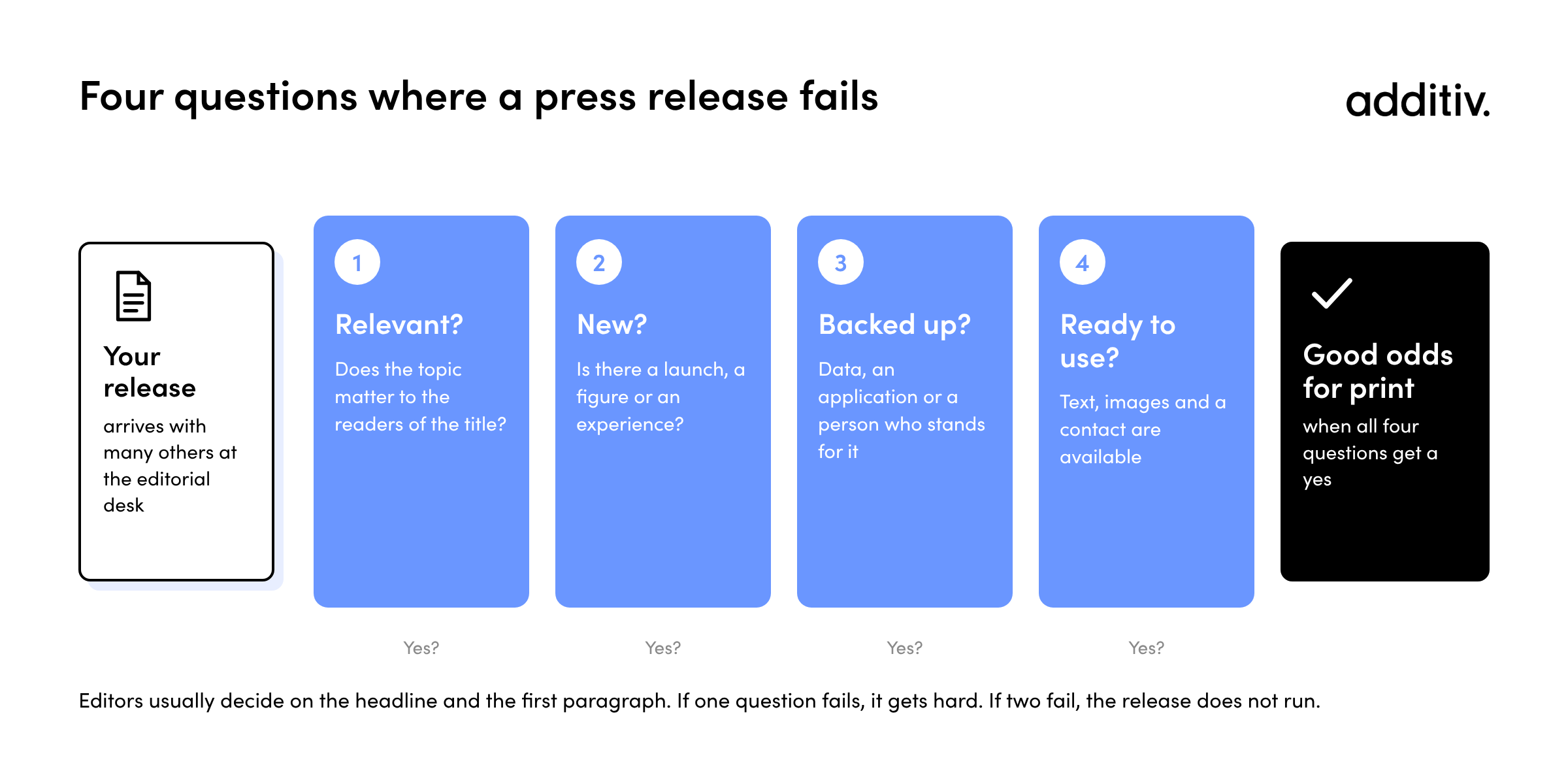
A trade editor decides what goes into the magazine with four questions. Most editors answer them in seconds. Ask yourself the same four before every send:
- Is it relevant to my readers? Does the topic concern the industry the magazine serves and the people who read it?
- Is it new? Is there a figure or an experience that hasn’t been published in this form?
- Is it backed up? Is there data or a real application? Does a named person stand behind it?
- Can I use it right away? Are text and images ready with hardly any rework? Is a contact person available?
Fail one, and it gets tough. Fail two, and the release won’t run. The editors have plenty of other offers on their desk that pass all four.
Then there’s the calendar. Trade journals work with editorial calendars that they often publish for the whole year in their media kits. An issue focused on order picking wants picking material in spring. Send a release on charging technology that month, and you’re fighting uphill. Even if your story is actually good.
And there’s one line many people underestimate. Editorial and advertising are separate. Section 7 of the German Press Code, issued by the German Press Council (Deutscher Presserat), requires publishers and editors to ensure a clear separation between editorial content and content published for advertising purposes. Booking an ad therefore doesn’t buy you editorial coverage. Reputable trade media stick to this rule.
Which mistakes cost the most coverage?
Most releases fail because of the same seven mistakes. Go through the list honestly. Chances are you’ll recognize your last release in at least one of them.
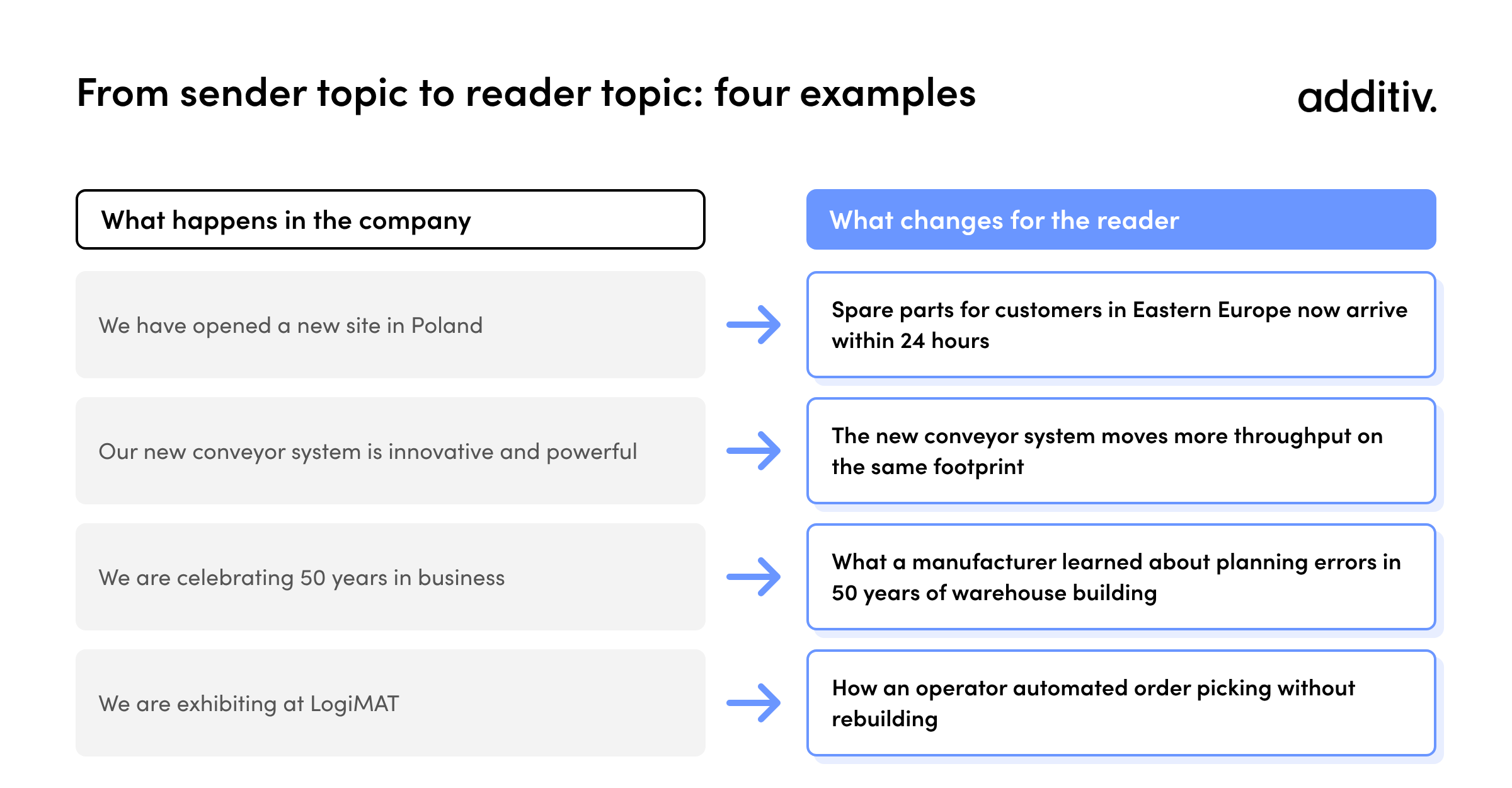
The topic is about the sender. The release reports what is happening inside your company: a new site, a new hire, a trade show appearance, a company anniversary. Nothing changes for the reader. Ask yourself instead: What can a warehouse operator or a planning firm do differently after reading my release?
The language is advertising. “Innovative,” “leading,” “holistic” and “unique” are claims without proof. Editors cut them. Or they set the release aside right away, because they would have to rewrite the whole thing.
The facts are missing. New conveyor technology without throughput, dimensions, application area and availability can’t be assessed. Trade media readers want numbers. So do the editors.
The benefit is buried at the bottom. Many releases start with the company and end with the result. Editors read it the other way around. The most important point belongs in the headline and the first sentence.
The material is unusable. A 72 dpi product shot, a cut-out rendering with no real environment, no caption, no credit line. No printed magazine can work with that.
The distribution list is too broad. A release that goes to the business press and twenty trade titles at the same time is written for none of them. A trade editor spots that instantly.
The schedule replaces the story. “We send something out every month” is a plan for the sender. In a month with no story, you get a release with no story. After the third of those, the editors stop reading the fourth closely.
Why is your competitor in every other issue?
Competitors who show up in the trade press all the time offer editors more than press releases. That stings when you dutifully send out your release every month and still come up empty. Look at what your competitor delivers instead:
- Case studies, in which a customer explains what has changed in their operation
- Bylined articles, in which an expert answers a question many in the industry are asking
- Experts as sources, whom editors can contact for market overviews and background pieces
- Topics that match the editorial calendar, pitched in good time
Behind this there’s usually a way of working that doesn’t need a big budget. Someone in the company or at the agency knows the editorial calendars and the people in the newsrooms. That person knows which issue is looking for which topic. The press release then becomes just one tool among several.
Two examples from our work show what this can achieve. For Wiferion, it generated 256 publications in 2025. For Safelog, the count came to more than 676 clippings over three reporting periods, including coverage in Handelsblatt and FAZ.
What works better than a press release?
Finished content that editors don’t have to build themselves works better than a press release, such as a case study or a bylined article. The press release is still the right format for real news. Think of a new product, an acquisition, a major order or a figure the industry cares about. For almost everything else, there are better ways into the magazine.
- The case study tells the story of a real customer deployment, from the starting point to the result. Quotes and images come from the operation. Trade journals like to print it because readers recognize themselves in it.
- The bylined article answers a question that goes beyond your product. For example: What matters when planning an automated warehouse? It is often written exclusively for one publication.
- The editorial meeting brings an expert with a topic to the editors. You don’t need a finished text for it. Interviews and background pieces grow out of it. Often you’re left with a contact that lasts for years.
If you use these formats, you need fewer press releases. And the ones you still send get read more closely, because the editors know you by now.
How do you get your story to the editors?
You get your story to the editors with a personal pitch to the right person at the right time. Above all, that takes preparation. Here’s how to go about it:
- Frame the topic from the reader’s point of view. One sentence: What will readers learn that they didn’t know before?
- Choose the right media. Five titles whose readers fit exactly beat forty that fit somehow.
- Check the editorial calendars. The media kit shows which issue has which focus and when the editorial deadline is.
- Find the responsible editor. The masthead or the website lists who covers what. An email to the general newsroom address is the weakest route.
- Keep the pitch short. Write three or four sentences on the topic, why it fits now, which format you offer and what material is available. Don’t attach a finished text on first contact.
- Have material ready. You need print-quality images with captions and the data. Add a contact person who can be reached.
If the editors say yes, deliver on time and at the agreed length. If they say no, ask why. The answer will help your next pitch more than any checklist.
How can you tell that things are changing?
You can tell things are changing by the coverage you get. The number of releases you send tells you little. Three things are worth watching:
- How many articles appear and in which media. A case study in a leading industry title carries more weight than ten short items on online portals.
- What form they take. Do only shortened releases appear, or are full articles and interviews coming out?
- Whether editors approach you on their own. That is the clearest sign that your company is seen as a source.
And that gives you your answer for management, too. They are right to ask what press relations deliver. A list of publications in the right media answers that better than any mailing statistics.
If you’re looking for support: Our press relations for B2B companies start at exactly this point. For our work for the Open Logistics Foundation, we won the German Agency Award 2026 (Deutscher Agenturpreis) in the “B2B / PR” category.
Frequently asked questions
How often should a company send press releases to the trade press?
As often as there is real news. A fixed monthly schedule leads to releases without a story. Editors then read the sender less carefully. Many mid-sized companies do better with a few strong releases a year. Case studies and bylined articles complement them.
Does an ad help you get editorial coverage?
No. Reputable trade media keep advertising and editorial separate. Section 7 of the German Press Code requires it. Paid formats such as advertorials must be recognizable as advertising. They are no substitute for editorial coverage.
What is the difference between a press release, a bylined article and a case study?
The press release announces news and goes to many media outlets. The bylined article covers a specialist topic beyond your own product and is usually offered to one publication exclusively. The case study describes a specific customer deployment, from the starting point to the result.
How long should a press release for the trade press be?
Short enough for the key message to sit in the first paragraph. Long enough for the technical facts. In practice, one page is usually enough. Further details belong in a data sheet or on a web page the release links to.
Is a press portal worth it if the trade press won’t print your release?
A portal puts the release online. It won’t get it into the magazine. That can help findability. It is no substitute for coverage in a trade journal, because there an editor made the selection. That is exactly what gives it value for readers.
Is it okay to follow up with an editor on whether the release will run?
Yes, once and with a reason. A short follow-up with something extra is welcome. Think of an image from a deployment or a person available for an interview. Repeated chasing without new content does harm.
Why does the trade press shorten press releases?
Because space is limited and editors only keep what matters to their audience. Promotional passages and quotes that say nothing go first. The company description usually follows right after. If you put the key message up front, it survives the shortened version too.
