Trade fair PR timeline for LogiMAT 2027: what needs to happen 16 weeks before the show
Your stand for LogiMAT 2027 is booked. Your launch is almost ready. So what about the press work? Start now and your timing is right. Wait until February and you will mostly be reading about other exhibitors in the trade press.
Contents
- Why do so many LogiMAT exhibitors get so little press coverage?
- When should press work for LogiMAT 2027 start?
- What does the timeline up to the fair look like?
- What belongs in a LogiMAT press kit?
- How do you get editorial meetings at your stand?
- Which trade media matter for LogiMAT?
- What happens after the fair?
- Frequently asked questions
Key points at a glance
- Press work for LogiMAT 2027 starts at the end of November, around 16 weeks before the fair opens on 16 March.
- By Christmas, your story and your material are in place.
- The first press release goes to the trade media in December or January, so your launch makes it into the show previews.
- February is the month for personal invitations to editorial meetings at your stand.
- In the three weeks after the fair, you follow up so that conversations turn into published articles.
- Start only in February and you will often miss the previews.
Why do so many LogiMAT exhibitors get so little press coverage?
Because their press work starts too late. Many exhibitors spend months planning their stand and exhibits. The press release, by contrast, often gets written in the final two weeks. For many editorial teams, that is too late. Their show previews are usually planned by then. Many of their meeting slots are already taken.
Plenty of marketing managers in intralogistics know what happens next. The stand is busy. Most visitors, however, are passers-by and competitors. The company does not appear in the trade media. And when management asks what the fair delivered, there is no good answer.
Yet LogiMAT is an important stage for intralogistics. Trade journalists arrive at the Stuttgart exhibition centre with a clear brief: find new products and gather stories for the months ahead. If you gave them a topic in advance, you are on their list. If you hope to catch their eye at the stand, you are relying on luck. Coverage depends on whether an editor understands why your launch matters to their readers. The number of releases a company sends has little to do with it.
When should press work for LogiMAT 2027 start?
Press work should start at the end of November 2026. LogiMAT 2027 runs from 16 to 18 March 2027 in Stuttgart. Counting back from the opening day, press work needs around 16 weeks:
- four weeks for the story and material, until shortly before Christmas
- two weeks off over the holidays
- four weeks for the press release and the previews, mainly in January
- four weeks for invitations and scheduling, in February
- two weeks for the final run-up to the fair, in early March
Trade magazines plan the topics for their show previews several weeks before publication. The exact editorial deadline is listed in each title’s media kit. Checking it is a job for week one.
What does the timeline up to the fair look like?
The timeline follows a simple logic: the story comes first, then the media. Meetings build on both.
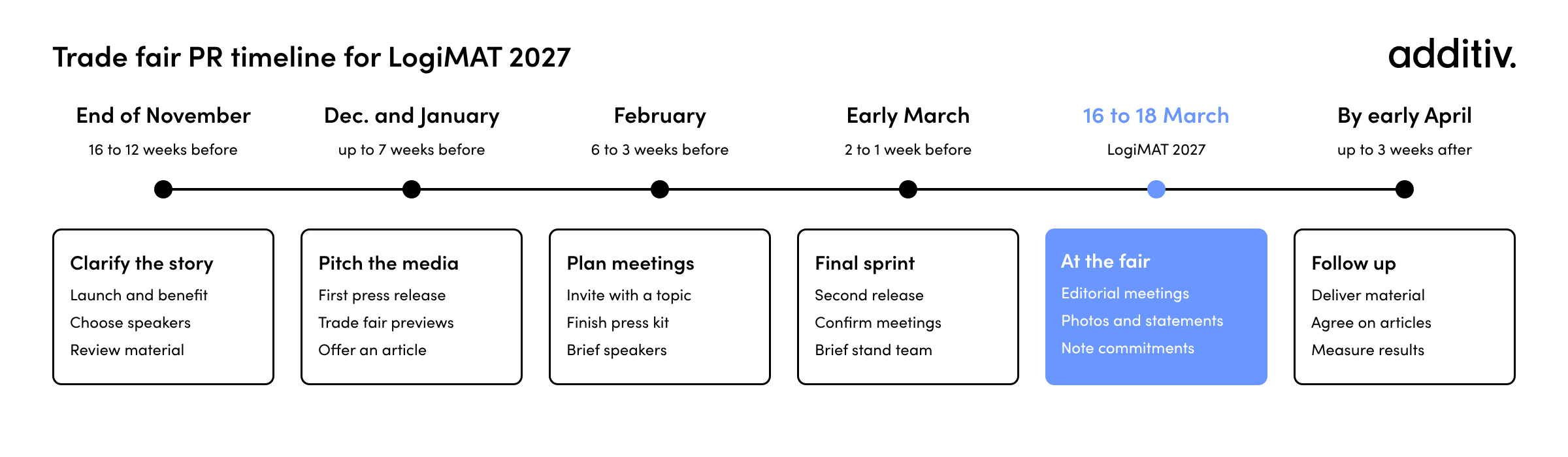
End of November to Christmas (16 to 12 weeks before): clarify the story
- What are you launching? Why does it matter to companies that run warehouses and production?
- Who speaks for the company? Ideally someone from engineering or management who is comfortable talking to journalists.
- What material do you already have? Think images, data, application examples or a customer willing to talk.
- Check whether to enter the launch for the LogiMAT “Best Product” award. The organiser publishes the conditions and the submission deadline.
December and January (up to 7 weeks before): pitch the trade media
- Send the first press release on the launch to the trade media, with images and technical data.
- Check the media kits for preview issues and offer topics that fit them.
- Where it makes sense, offer a technical article for publication after the fair.
February (6 to 3 weeks before): schedule meetings
- Send personal invitations to editorial meetings at the stand, each with a topic.
- Finalise the press kit, in digital form and in print for the stand.
- Prepare your speakers with key messages and the three most likely questions.
Early March (2 to 1 week before): final run-up
- Issue a second press release if there is news, such as a premiere or a customer.
- Confirm meetings and brief the stand team. Who receives journalists? Where can you talk undisturbed?
- Prepare LinkedIn posts for the fair.
16 to 18 March 2027: at the fair
- Hold the editorial meetings. Capture photos and short video statements.
- Note who promised what and who asked for what.
Until early April (up to 3 weeks after): follow up
- Deliver the promised material and agree on articles. Approve interviews.
- Collect the coverage and evaluate it.
What belongs in a LogiMAT press kit?
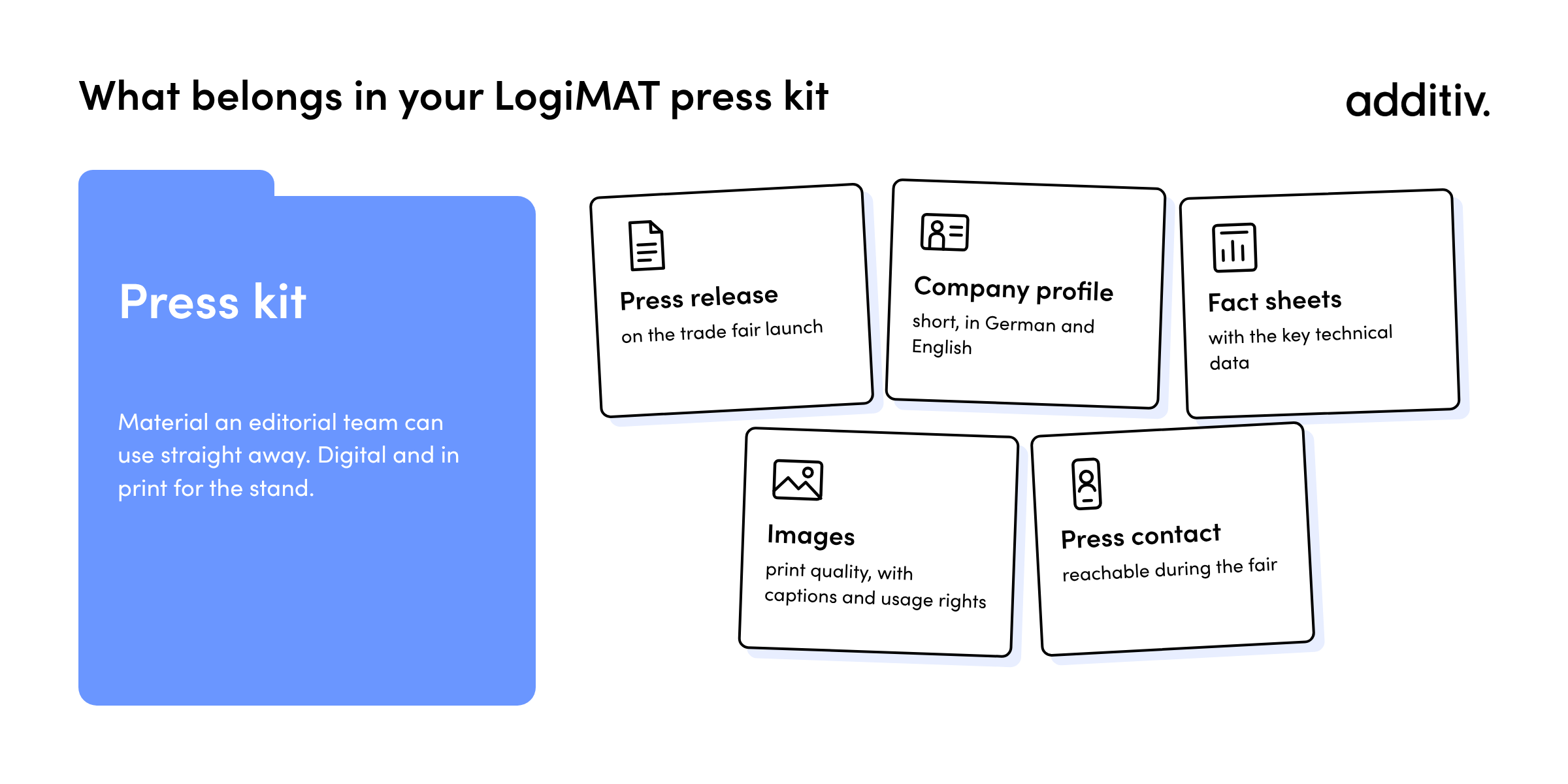
Above all, a LogiMAT press kit needs material an editorial team can use straight away. That means:
- the current press release on your launch
- a short company profile in German and English
- one or two product fact sheets with the key technical data
- print-quality product images and portraits of your speakers, with captions and usage rights
- a press contact with a phone number who can also be reached during the fair
Online, the kit should have its own page on your website so that journalists can find it before and after the fair.
How do you get editorial meetings at your stand?
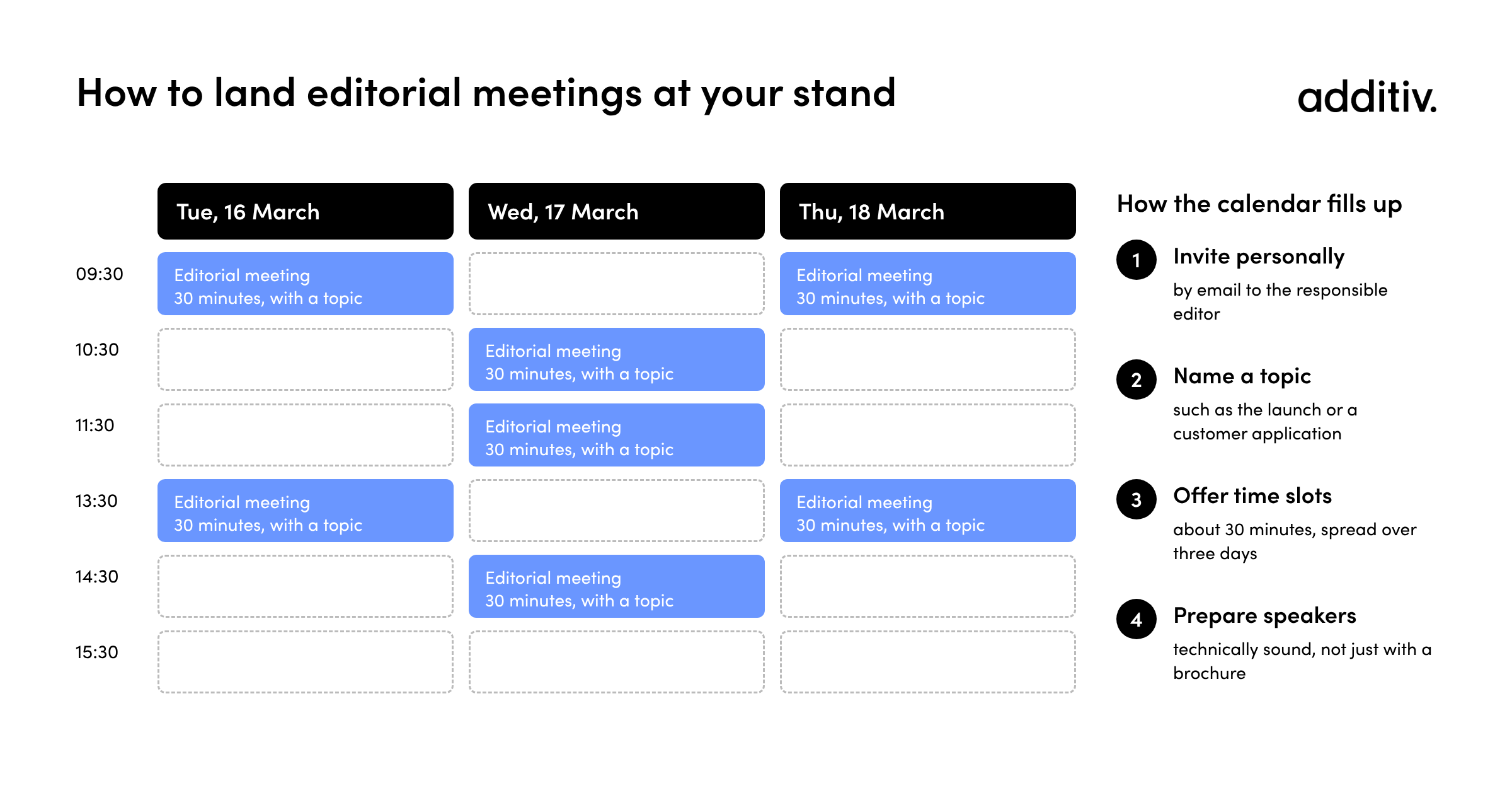
You need a concrete topic to offer. At LogiMAT, editors usually have little time and receive many requests. A meeting happens when it is clear what you will discuss and why it matters to their readers.
Here is how to go about it:
- invite the responsible editor personally by email
- name a concrete topic, such as the launch or a customer application
- offer fixed slots of around 30 minutes spread across the three days of the fair
- prepare speakers who can answer technical questions
A press conference only pays off for a launch with genuine news value. For most exhibitors, one-to-one meetings achieve more because each editorial team gets its own angle.
Which trade media matter for LogiMAT?
For intralogistics, the key German trade titles include LOGISTIK HEUTE, DVZ, MM LOGISTIK, f+h and dhf Intralogistik. For conveyor technology and cranes, Hebezeuge Fördermittel completes the list. Depending on the topic, titles covering production or automation come into play. For software topics, the same applies to IT media.
If you sell internationally, you also need an English press release. LogiMAT draws trade visitors from many countries. International media cover the fair as well. A good translation is usually not enough. Technical terms and number formats have to suit English-speaking readers. The same goes for the examples.
What happens after the fair?
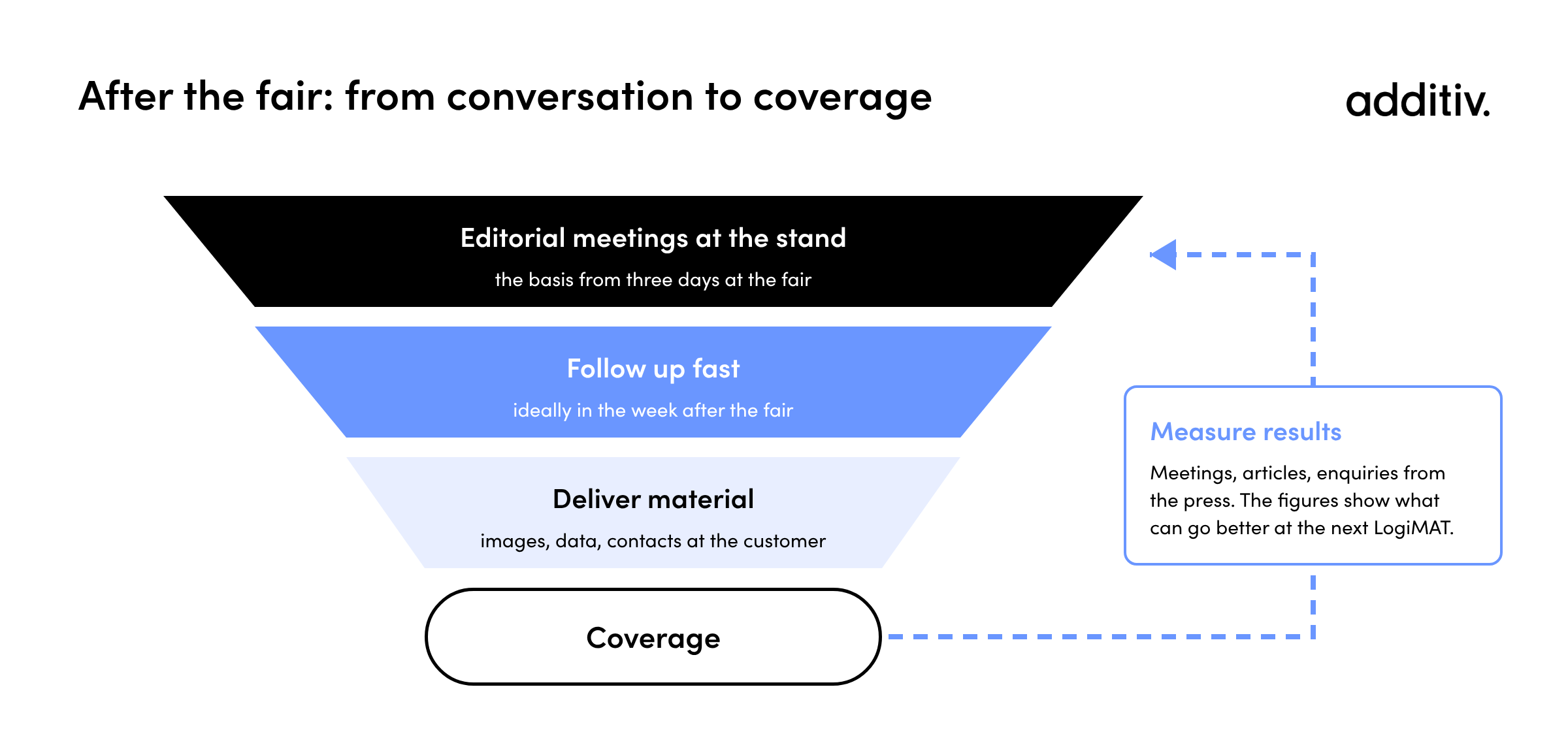
Press work carries on after the fair. Much of the coverage appears in the following weeks as follow-up reports, technical articles, interviews and case studies.
Three things decide whether conversations turn into articles:
- follow up, ideally in the week after the fair
- deliver promised material such as images or contacts at the customer
- measure the results: how many articles came out of the editorial meetings? Which enquiries came in through the press?
These figures are the best answer when management asks what the fair delivered. They also show where the next LogiMAT can go better.
If you are an international exhibitor and would rather not handle LogiMAT press work on your own, take a look at our packages under PR for LogiMAT 2027 exhibitors.
Frequently asked questions
Is one press release in the week of the fair enough?
No, a release sent during show week usually gets lost. By that point, editors have generally mapped out their LogiMAT reporting. They are also flooded with announcements from other exhibitors. December or January is the better moment, while the preview issues are being written.
Is a press conference at LogiMAT worth it?
A press conference at LogiMAT is usually worthwhile only when your launch is real news. It competes for attention with plenty of other appointments. To meet several editors at once, invite them to a small briefing at your own stand instead.
Do I need a press release in English?
An English version of your release is essential if you sell abroad or want to reach visitors from outside Germany. Send it out on the same day as the German version. Many international trade titles also plan their show coverage well ahead.
How long should a trade fair press release be?
A trade fair press release should run to around 2,000 to 3,000 characters. That leaves room for the launch, its benefit, the key figures and a quote. Anything more detailed goes in the fact sheet.
How much lead time do stand meetings with editors need?
Invitations for meetings with editors at your stand should go out three to six weeks before LogiMAT opens. Sent too early, they are forgotten by the time the show starts. Sent too late, they land in calendars that are already full.
How do I measure the success of trade fair PR?
You measure trade fair PR by the meetings you held with editors and by what they publish in the weeks that follow. Enquiries generated by press coverage count as well. Reach figures alone say little about whether you got through to the right audience.
What should I post on LinkedIn around the fair?
On LinkedIn, the strongest posts follow the fair from the first preview to the final round-up. Beforehand, give a glimpse of your preparations and the launch. During the show, short posts from the stand work well. Afterwards, sum up the conversations that mattered most. LinkedIn supports your press work without replacing it.
