Pitching a topic to the trade press: How to offer editors a story
Your email to the editors went out on Tuesday. Press release attached, sent to the general newsroom address. Now it’s Tuesday again. Your inbox is empty. Do you follow up? Or do you let it go because you don’t want to be a nuisance? The answer lies in that first email. A good pitch is short and goes to exactly one person. In a few sentences, it says what readers will learn and why the timing fits. It also names the material you can provide. If you pitch like this, you get answers. If you send a finished press release to the general newsroom address, you often don’t.
Contents
- What is a topic pitch, and when does it beat a press release?
- Who on the editorial team should you write to?
- What does a good pitch email look like?
- Which subject line gets opened?
- When is the right time to pitch?
- Email or phone?
- How do you follow up without being a nuisance?
- What do you do after a rejection or silence?
- Frequently asked questions
Key takeaways
- A pitch offers a topic before the text is written. The editors help decide what it turns into.
- It goes to the person responsible for that section.
- The email has five to seven sentences: a personal reference, the topic from the reader’s point of view, the occasion, the format, the material and a contact person.
- The subject line names the topic in concrete terms. Promotional words and “press release” in the subject line hurt your chances.
- If you know the publication’s editorial calendar, you pitch at the right time.
- Follow up once. After that, offer the topic to another publication.
What is a topic pitch, and when does it beat a press release?
A topic pitch is a personal offer to an editorial team. You suggest a topic before a finished text exists. The editors accept or decline. Sometimes they ask for a different angle. Only then does the article get written.
A press release announces news to many media outlets at once. A pitch goes to a single editorial team. It suits formats that editors don’t want to share with other titles: case studies, bylined articles, interviews and background briefings. For these formats, the pitch is the usual route. Do you have a customer who would talk openly about their deployment? Then that story belongs in a personal email to exactly that editorial team.
Why is it worth the effort when the trade show and social media are also on your plate? Because trade editors plan ahead. An article they agreed on in advance has a fixed place in the issue. A press release sent without prior agreement competes with everything else that arrives that day. Our article Why editors don’t print your press release explains why so many releases get lost along the way.
That leaves the question of who your pitch goes to.
Who on the editorial team should you write to?
Write to the person on the editorial team who is responsible for the topic. At a trade journal, each section usually has its own contact, for example for warehouse technology or drives. At small titles, the editor-in-chief often decides personally.
How to find the right person:
- Read the masthead. Trade journals list their editorial team there, often with areas of responsibility. For journalistic and editorial online services, such as a trade journal’s website, Germany’s Interstate Media Treaty (Medienstaatsvertrag), section 18(2), requires a responsible person to be listed with name and address.
- Read the articles. A quick search of the archive shows who last wrote about your topic. That person is the best one to contact. And you have the hook for your first sentence right there.
- Check the media kit. It often lists the sections and the contacts for bylined articles.
- Talk to editors at trade shows and events. A face to go with the name makes your next pitch easier. You’ll be at the show anyway.
The general newsroom address is the weakest route. Emails sent there land in an inbox that many people read. Nobody feels responsible for them. Maybe that’s where your email from last Tuesday is sitting, too.
You have the name. Now for the email itself.
What does a good pitch email look like?
A good pitch email is short. Five to seven sentences are enough. Each one has a job:
- A greeting by name and one sentence on why you are writing to this particular person.
- The topic from the reader’s point of view. What will someone reading the issue learn?
- The occasion. Why does it fit now? It might match a focus in the editorial calendar or an upcoming trade show.
- The format. Which type of text are you offering? Roughly how long will it be?
- The material. Is there a customer willing to talk? Are there images from the deployment?
- The contact person, with a phone number.
What doesn’t belong in the first email: a finished text as an attachment or large image files. That’s hard when the finished text has long been sitting on your computer. Still, the editors first want to know whether the topic fits.
Here is an example of how such an email can sound:
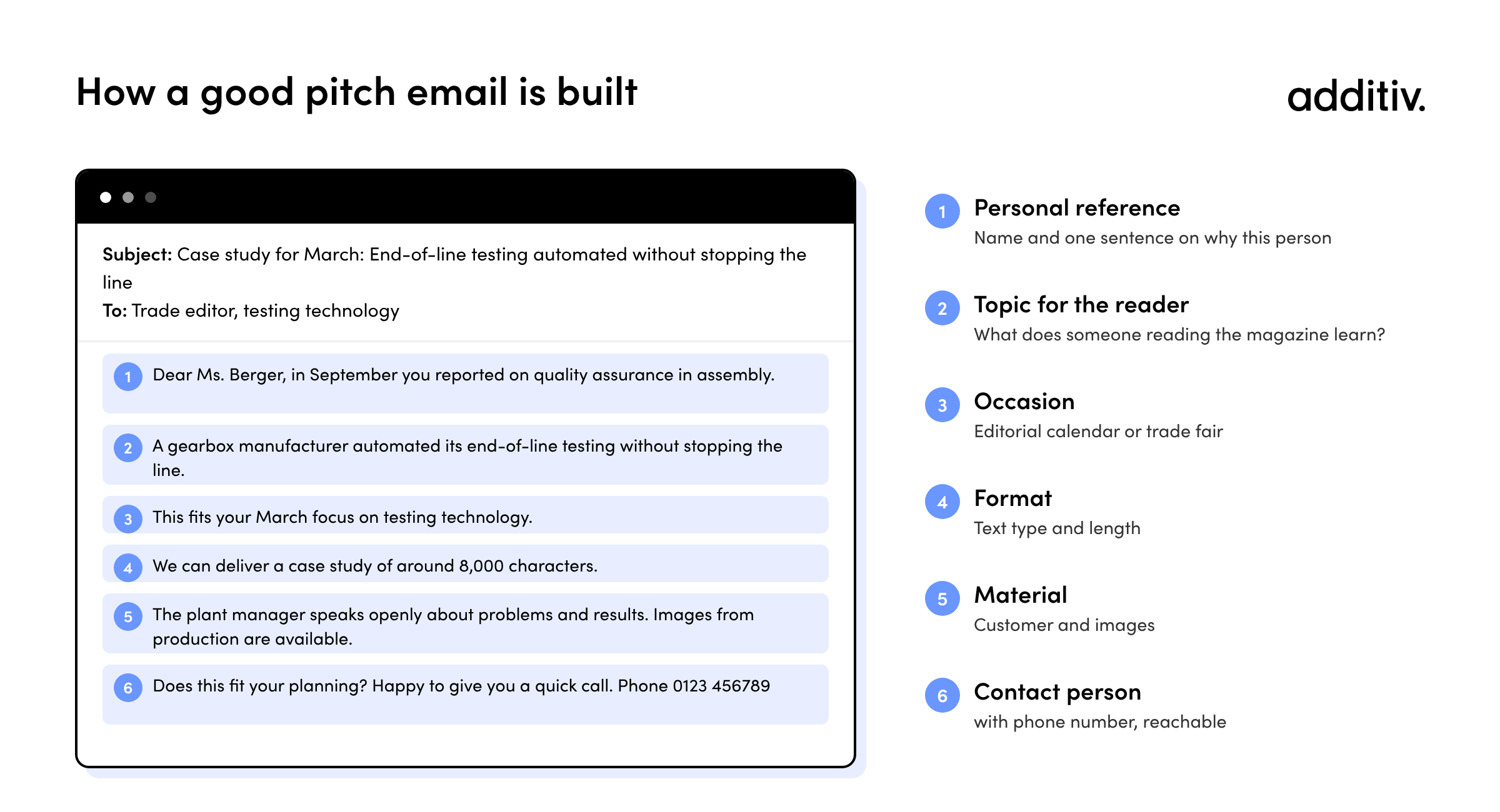
“Dear Ms. Berger, in September you reported on quality assurance in assembly. We have a related topic for your testing technology focus in March: A gearbox manufacturer automated its end-of-line testing without stopping the line. In a case study, the plant manager would speak openly about problems and results. We can deliver around 8,000 characters, with images from production and figures on testing time. Does this fit your planning? I’d be happy to give you a quick call. You can reach me at +49 261 123456.”
The names and details are made up. The structure is the one we use ourselves. Go ahead and check it off: reference, topic, occasion, format, material, contact person. It’s all there, in seven sentences.
Before Ms. Berger reads a single one of them, though, she sees something else: the subject line.
Which subject line gets opened?
The subject line that gets opened names the topic in concrete terms. Editors sort by subject line. If it says “press release” or just a company name, the email has often been filed before anyone reads it.
Subject lines work better when they state the topic and the format:
- “Case study for March: End-of-line testing automated without stopping the line”
- “Bylined article pitch: What manufacturers underestimate when automating end-of-line testing”
- “Interview offer: How a mid-sized company reorganized its quality assurance”
Keep the subject line factual and skip the exclamation points. It is the first sentence of your pitch. Sometimes it’s also the only one anyone reads.
A good subject line won’t help you much, though, if the issue has already been planned.
When is the right time to pitch?
The right time to pitch is several weeks before the editorial deadline of the right issue. You’ll find that date in the media kit. Many trade journals publish their editorial calendar for the entire year there. It lists the focus for each issue and usually the editorial deadline.
This leads to a simple process:
- Read the editorial calendar and mark the issues whose focus matches your topic.
- Count back from the editorial deadline. A case study needs time for the interview and for approval by the customer.
- Pitch early so the editors can plan the space.
Before major trade shows such as LogiMAT or Hannover Messe, editorial teams are especially busy. You probably are, too. If you want to appear in those issues, you have to start earlier. Our trade show PR timeline shows what that looks like for LogiMAT 2027.
And the perfect day of the week? The day of the week matters less than people often claim. It matters more to leave the editors alone with new ideas in the week before the deadline.
Now all that’s left is how to reach the editors.
Email or phone?
Email and phone work best together, in the right order. We often call first. An editorial team receives many emails every day and few calls. A call forces you to explain the topic in two or three sentences. And it gets you an answer right away, even if the answer is no.
For a call to work, it needs preparation:
- Know what the person wrote most recently.
- Be able to state the topic in one sentence.
- Ask whether it’s a good time. If it isn’t, offer to call back later.
- Send the email after the call, covering everything you discussed.
If you don’t like the phone, send the email first. About a week later, follow up with a call. What counts in the end is that one person talked to another about a topic.
How do you follow up without being a nuisance?
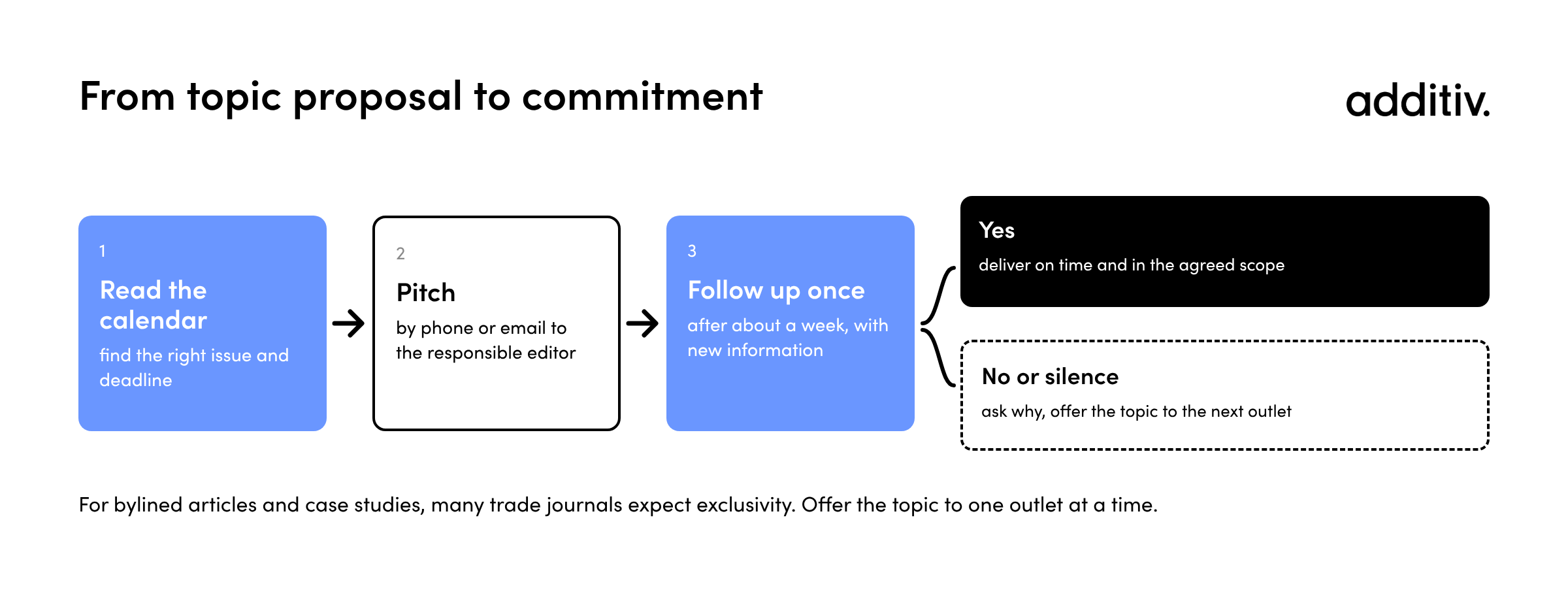
To follow up without being a nuisance, do it once and give a reason. That brings us back to the email from the beginning, which has gone a week without a reply. A press release sent to the general newsroom address isn’t worth following up. Send a pitch to the responsible editor instead. We recommend checking in once about a week later. Keep the follow-up short. Ideally, it brings something new, such as an image or a date when the customer is available for an interview.
A follow-up email can sound like this: “Dear Ms. Berger, I wanted to briefly check whether the topic might work for your March issue. The plant manager would have time for an interview in the next two weeks. If it doesn’t fit, that’s perfectly fine.”
Three sentences. And they come with an offer: the interview slot with the plant manager. Daily follow-ups with nothing new are annoying. A bare “Did you get my email?” with no further sentence is just as annoying. Editors remember senders. For better or worse.
And what if your follow-up gets no reply either?
What do you do after a rejection or silence?
After a rejection or silence, offer the topic to another publication. Even a rejection contains information. Ask for the reason. Maybe the topic doesn’t fit the magazine. Maybe the timing is wrong. The answer improves your next pitch.
If you get no reply after your follow-up, treat the topic as available again. If you offered exclusivity, say so briefly: “I’ll offer the topic to another publication, then.” That keeps the relationship clean.
And sometimes the topic simply isn’t right for this publication. Then it helps to tailor your next offer more closely to the editorial calendar.
When management asks what press relations deliver, one topic in the right issue counts for more than a full outbox. If you’re looking for support: Our press relations for B2B companies are built on exactly these conversations with trade editors.
Frequently asked questions
How long should a pitch email to a trade editor be?
Five to seven sentences. The email names a personal reference, the topic, the occasion, the format, the material and a contact person. Editors need nothing more for a first decision.
Should I send a finished text along with it?
No, not on first contact. The editors first want to decide whether the topic fits. Offer a finished text once they show interest.
Can I pitch the same topic to several trade journals at once?
For press releases, yes. For bylined articles and case studies, usually not. Many trade journals expect exclusivity for these formats. Pitch the topic to one publication after another. Say openly when you plan to pass it on.
When should I follow up?
We recommend once, after about a week. Ideally, bring new information, such as an image or an interview date. After that, you can offer the topic to other media.
Isn’t calling intrusive?
No, as long as the call is prepared. Trade editors get many emails and few calls. For many journalists, a short call with a clear topic is more pleasant than another unanswered email.
What belongs in the subject line of a pitch email?
The topic and the format, in concrete terms and without promotional words. For example: “Case study for March: End-of-line testing automated without stopping the line.” The words “press release” don’t belong there.
Can I also pitch a topic via LinkedIn?
As a supplement, yes. A LinkedIn message is unlikely to replace an email or a call. A short message can help open the door. The actual pitch with all the details belongs in an email to the editor’s personal address.
