Visibility in ChatGPT: Why AI names your competitors and not you
Your head of sales is back from a meeting. The prospect already had a list of three suppliers from ChatGPT. Your company isn’t on it, but two of your competitors are. That’s rarely down to your product. It’s down to the sources AI uses to build its answer.
Contents
- Why does ChatGPT name your competitors and not you?
- Where does ChatGPT get the suppliers it names?
- Why isn’t your own website enough?
- What role does the trade press play in AI answers?
- How do you check whether your company is visible in ChatGPT?
- What can you do over the next few months?
- Frequently asked questions
Key points
- ChatGPT names the suppliers it reads about most often and most clearly in trustworthy sources.
- Its answers draw on what the model learned in training and on a web search run at the moment someone asks.
- Your own website is rarely enough on its own. AI systems rely to a striking degree on third-party sources.
- In industry, trade media are among these sources. Companies that appear there regularly stand a better chance of being named in AI answers too.
- Visibility in ChatGPT can be measured. You put a fixed set of questions to several AI systems over a period of weeks.
- If you act on this, you’ll need patience. New publications take months to show in AI answers.
Why does ChatGPT name your competitors and not you?
ChatGPT names your competitors because they appear more often and more clearly than your company in the sources the system reads. To begin with, this has little to do with quality. AI doesn’t test machines or visit reference customers. It summarises what others have written about a market.
Does that feel unfair? Then picture the question from the purchasing side. Someone there types: “Which manufacturers offer shuttle storage systems for medium throughput?” The AI replies within seconds with three or four names and a sentence on each. Nobody in purchasing reads ten websites any more. The list goes straight into the next meeting.
On the other side of the table is the strongest single question in our prompt research, and it’s still rising: How do I get my company into ChatGPT’s answers? Managing directors of mid-sized companies often ask it when sales mentions a list like that.
The good news: the mechanics behind it make sense. And you already know a lot of it from media relations.
Where does ChatGPT get the suppliers it names?
ChatGPT gets the suppliers it names from two sources: what the model learned in training, and a web search it runs for many questions at the moment they’re asked. Both routes lead back to texts that are publicly available somewhere. What isn’t written anywhere, AI can’t name.
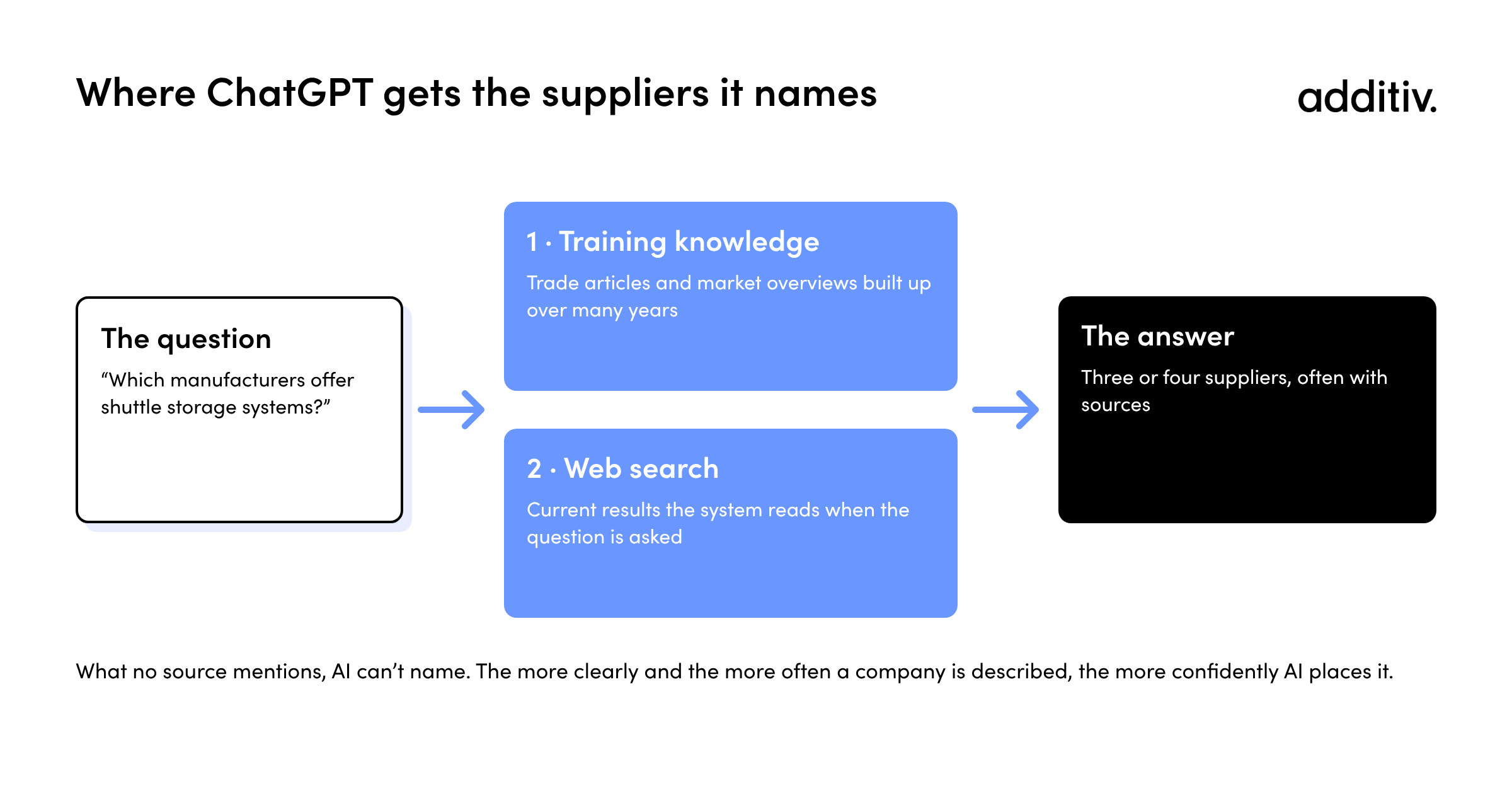
Training knowledge is the long-term memory. It comes from a huge number of public texts and is only renewed at long intervals. A company that has appeared in trade articles and market overviews for years is anchored there. A company that hardly anyone has written about isn’t.
Web search is the short-term memory. For questions about suppliers or current developments, ChatGPT searches the web and reads a few results. It builds its answer from them. Often it cites the sources as well. In our monitoring, other AI systems and the AI answers in Google Search also regularly cite their sources.
There’s also a quirk many people underestimate: AI likes clarity. If five sources describe a company in the same terms, the system can place it with confidence. If the website says “intralogistics solutions” and the press release says “automation partner”, the picture blurs. When in doubt, AI names the supplier with the clearer profile.
Why isn’t your own website enough?
Your own website isn’t enough because AI systems prefer to cite third parties over the supplier itself when the question is “Who is good?” There’s data on this. In 2025, a research team including Nick Koudas compared which sources AI search systems and Google use. Their finding: AI systems rely systematically and much more heavily on third-party sources, meaning coverage of a brand by others, such as the media. Brands’ own pages appear less often. Google’s mix is more balanced.
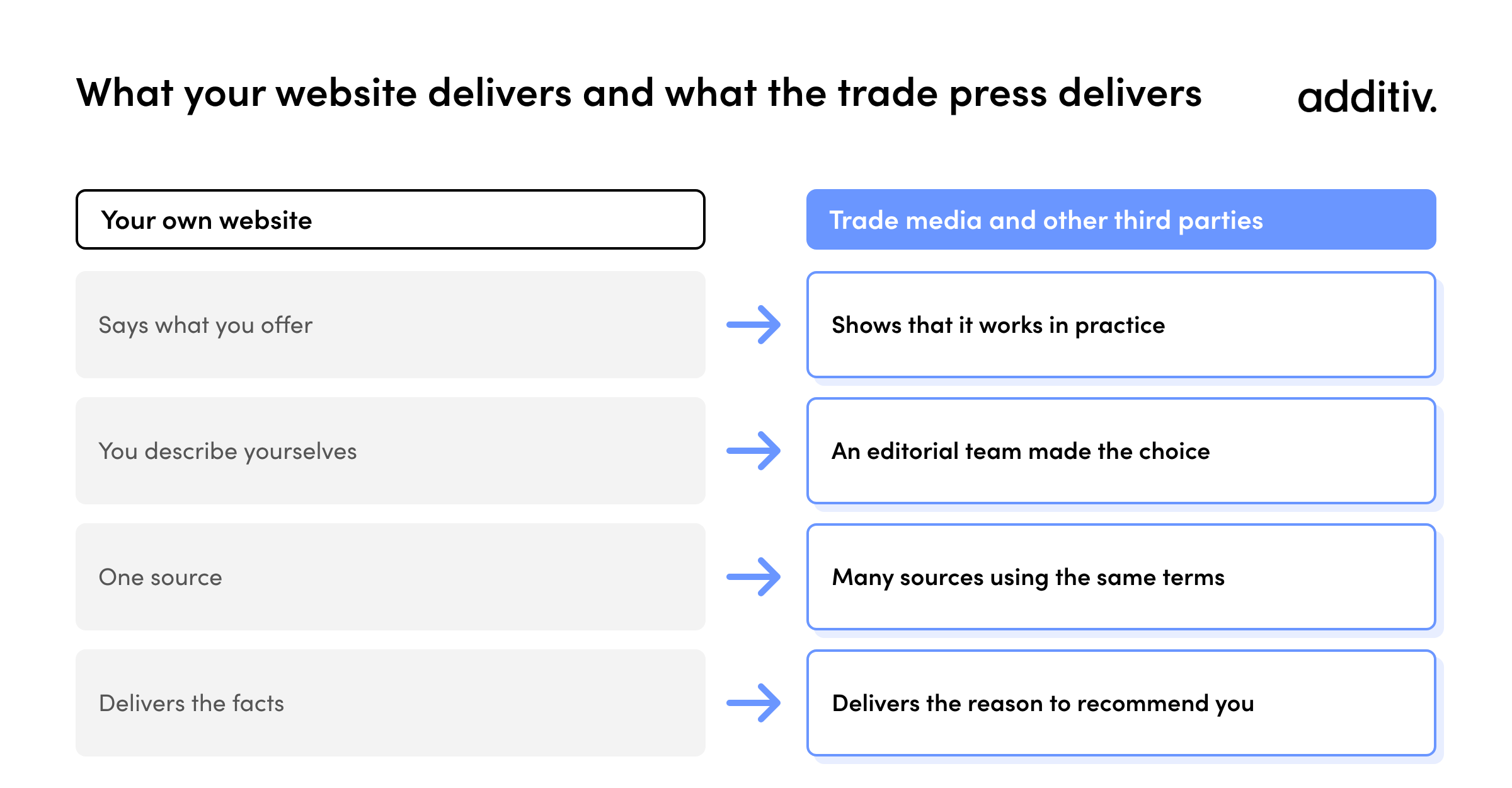
That sounds like bad news for anyone who has just put a lot of money into their website. It’s not quite that simple. The website still matters. It’s where AI looks up exactly what a company offers and for whom. If it’s outdated or blocks the crawlers of AI providers, something important is missing.
But the website is you describing yourself. Confirmation has to come from outside. Imagine asking a colleague for a good supplier. She’s unlikely to recommend the one with the nicest brochure. She’ll name the one she keeps hearing about in the industry. AI systems behave in a surprisingly similar way.
What role does the trade press play in AI answers?
The trade press plays an important role in AI answers in industry because it’s one of the independent third-party sources that AI systems rely on heavily. A case study in an intralogistics trade journal describes a product in real use. An editorial team chose what got published. For AI, that’s a strong signal.
For you, this means every appearance in the trade media does double duty. It reaches the people who read the magazine or newsletter. And it becomes a building block that AI systems use for their answers. This applies in particular to formats that place your company in a factual context:
- Case studies, in which a customer describes what has changed in their operation
- Technical articles, in which your experts answer a question the industry is asking
- Market overviews, in which editors compare the suppliers in a segment
- Interviews and comments, in which someone from your company speaks for the industry
So the competitor who turns up in every other issue has a double head start. They’re present for readers. And they’re present in the sources ChatGPT draws on. We’ve described why some companies appear all the time and others never do in Press releases and the trade press: Why editors don’t print yours.
There’s a limit, too. A single publication won’t change an AI answer overnight. Impact builds through repetition and time. Your reputation in the industry builds in much the same way.
How do you check whether your company is visible in ChatGPT?
You check whether your company is visible in ChatGPT with fixed questions your customers ask, put to several AI systems over several weeks. A single test at your desk tells you little. AI answers vary from one query to the next.
You can still start today. Here’s how:
- Write down ten questions the way purchasing would ask them. Not “Who is the best supplier?”, but specific: product, application, size of operation, region.
- Put them to several systems. ChatGPT, Gemini, Perplexity and the AI answers in Google Search often return different names.
- Note for each answer who is named and which sources are listed. Are you there yourself?
- Repeat the test. Once a month with the same questions. Only then will you see a trend.
- Read the sources. They show you which media and portals AI draws on for your market. That’s where you need to appear.
Step five is the most valuable. The same two or three trade media and industry portals often come up again and again. That gives you the list your media relations work starts with.
We work the same way in our own monitoring, just more systematically. Fixed question sets per topic run through six AI systems on a fixed schedule. That turns a gut feeling into a figure for AI visibility you can discuss with management.
What can you do over the next few months?
Over the next few months, you can do two main things: describe your company the same way everywhere and appear regularly in the sources AI reads for your market. A readable website and a way of measuring impact go with them. That’s good communication, done consistently.
Say the same thing everywhere. Decide how your company is described in one sentence: what you offer and for whom. That sentence belongs on the website, in industry portals, in trade fair catalogues, on your LinkedIn profile and in every press release. The more consistent the description, the more confidently AI can place you.
Make your website readable. Check with your IT team or agency whether the website lets AI providers’ crawlers in. Clearly structured pages on services and reference projects help. So do questions and answers in full sentences.
Appear where AI looks things up. In industry, that mainly means trade media. Plan case studies and technical articles for the titles that came up as sources in your test. Offer your experts to editors as interviewees for market overviews.
Measure progress. Repeat your test every month. Expect the first movement to take several months.
And what do you tell management when they ask whether it’s worth it? The most honest answer: the list the prospect brings into the meeting is being drawn up right now. The only question is whether you’re on it.
You can do it yourself if someone in-house has time for it. That means testing every month and analysing the sources. You also need to know the editors and keep developing story ideas for the trade media that show up in the answers. If you don’t have the time or the contacts, it pays to hand the work over. Our GEO consulting for visibility in AI answers combines exactly that: monitoring the AI systems and media relations in the trade media they cite.
Frequently asked questions
Can you pay to be named in ChatGPT?
No, you can’t buy a mention in a ChatGPT answer. Since August 2026, ChatGPT has also shown ads in Germany. According to OpenAI, they’re clearly labelled and kept separate from the answers. If you want to appear in the answer itself, you have to appear in the sources it’s built from.
How long does it take for visibility in ChatGPT to improve?
It usually takes a few months for visibility in ChatGPT to improve. Answers that use web search react faster to new publications. The models’ training knowledge only changes with new model versions.
Is it enough to optimise your own website for AI?
No, a website optimised for AI rarely does the job alone for visibility in AI answers. It provides the facts about your company. But when the question is which suppliers to recommend, AI systems rely heavily on independent sources such as trade media.
Why do ChatGPT and Gemini name different suppliers?
ChatGPT and Gemini name different suppliers because they draw on different training data and search indexes. The way they weight sources differs too. A meaningful test therefore checks several systems.
What is the difference between SEO and visibility in AI answers?
SEO aims for a good ranking in a search engine’s results list, while AI visibility aims for a mention in the answer itself. There, an AI system names your company directly. What counts most are mentions in trustworthy third-party sources.
Does PR really help with visibility in ChatGPT?
Yes, PR in the trade media helps with visibility in ChatGPT because AI systems tend to draw on independent editorial sources. Every publication becomes a source from which AI builds its answers. The impact comes from many publications over a longer period.
How often should you check your visibility in ChatGPT?
Checking your visibility in ChatGPT monthly with an identical set of questions is enough for most mid-sized companies. One-off tests vary too much. Only repetition shows whether anything is moving.
