Press releases and the trade press: Why editors don’t print yours

You sent the release on Monday. Well written, with a photo. Your whole distribution list got it. Now it’s Friday. Not a word of it has appeared in any trade publication. Next month you send the next one. Again, nothing happens. The distribution list is almost never the problem. The problem is the question every editor asks before reading on: What do my readers get out of this?

Key takeaways

  • Trade editors pick what helps their readers. Who sent it comes second.
  • Most releases fail on the topic. They report what is happening inside the company. Nothing changes for the reader.
  • Promotional language and missing data turn a release into work for the editor. The same goes for unusable images.
  • Trade journals plan their issues based on editorial calendars that are often set for the whole year. If you miss the theme, you miss the issue.
  • Case studies and bylined articles appear more often than product news because they give editors ready-made content.
  • Targeted releases with a real story generate more coverage than a fixed monthly schedule.

Why doesn’t the trade press print your press release?

The trade press won’t print a press release when the editors can’t find a story in it for their readers. That sounds harsh. But it’s the most honest answer to a question we often hear from marketing leads in machinery and intralogistics. And the next question usually follows right behind it: What do I tell management when they ask what all this is for?

Picture the desk of a trade editorial team. A small crew fills a magazine every month, plus the website. Often there’s a newsletter on top. Lots of press releases land there every day. Nobody reads them all to the end. The decision happens at the headline and the first paragraph. If that spot holds an anniversary or “another milestone,” your release is out before the second sentence.

Editors aren’t being dismissive. Trade media live on reader trust. Decision-makers in industry pick up a trade journal because they find expert information on their own problems there. They want to know how others rebuilt a warehouse. They want to know what matters in an investment decision. A release that only celebrates the sender doesn’t fit that promise. That promise is your way in. Give the editors something that fits it.

How does a trade editor decide what goes into the magazine?

A trade editor decides what goes into the magazine with four questions. Most editors answer them in seconds. Ask yourself the same four before every send:

  • Is it relevant to my readers? Does the topic concern the industry the magazine serves and the people who read it?
  • Is it new? Is there a figure or an experience that hasn’t been published in this form?
  • Is it backed up? Is there data or a real application? Does a named person stand behind it?
  • Can I use it right away? Are text and images ready with hardly any rework? Is a contact person available?

Fail one, and it gets tough. Fail two, and the release won’t run. The editors have plenty of other offers on their desk that pass all four.
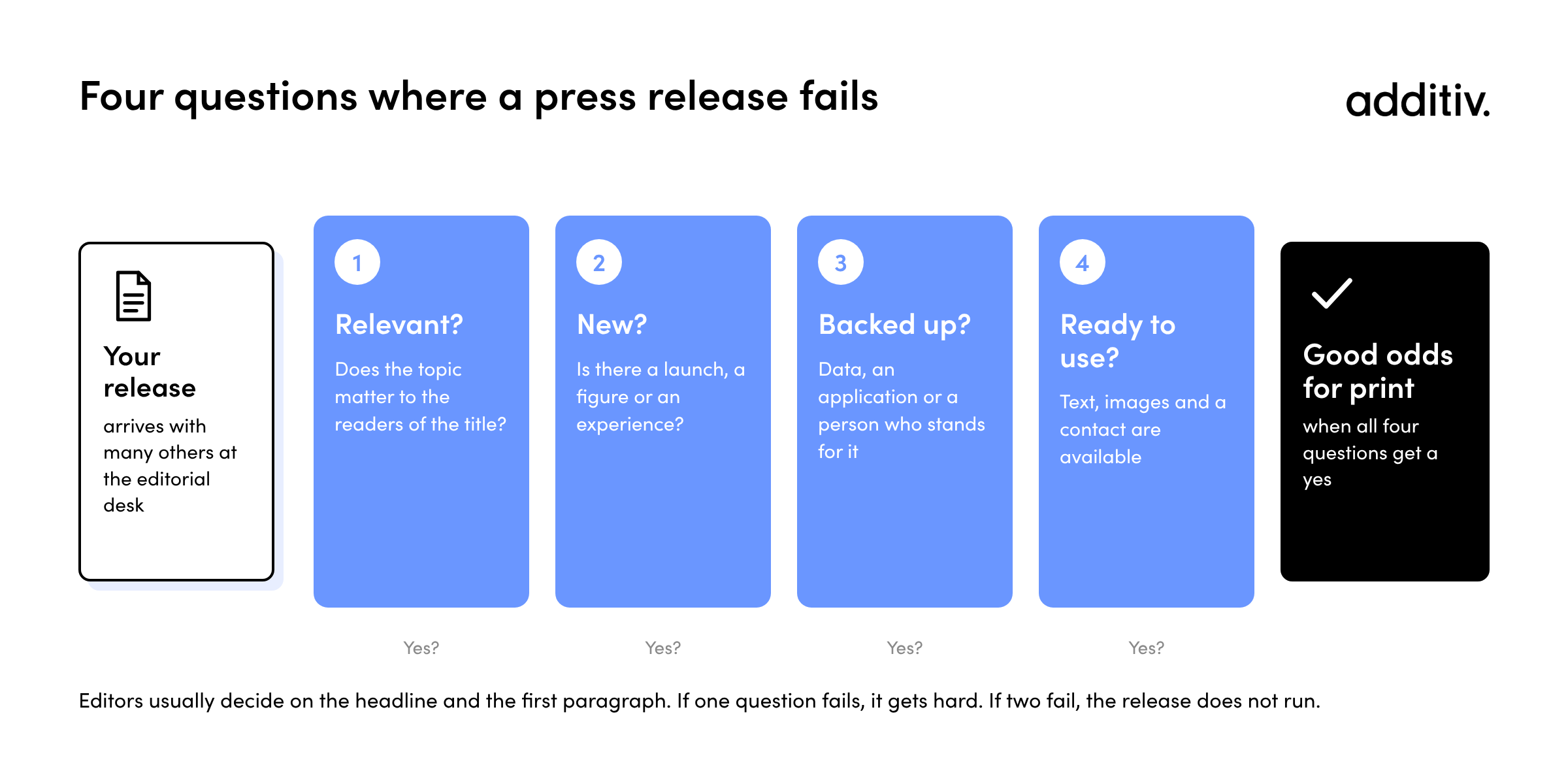
Graphic showing four questions a trade editor asks about a press release: Is it relevant to readers, is it new, is it backed up, is it ready to use. If one question fails, it gets hard; if two fail, the release does not run.

Then there’s the calendar. Trade journals work with editorial calendars that they often publish for the whole year in their media kits. An issue focused on order picking wants picking material in spring. Send a release on charging technology that month, and you’re fighting uphill. Even if your story is actually good.

And there’s one line many people underestimate. Editorial and advertising are separate. Section 7 of the German Press Code, issued by the German Press Council (Deutscher Presserat), requires publishers and editors to ensure a clear separation between editorial content and content published for advertising purposes. Booking an ad therefore doesn’t buy you editorial coverage. Reputable trade media stick to this rule.

Which mistakes cost the most coverage?

Most releases fail because of the same seven mistakes. Go through the list honestly. Chances are you’ll recognize your last release in at least one of them.

The topic is about the sender. The release reports what is happening inside your company: a new site, a new hire, a trade show appearance, a company anniversary. Nothing changes for the reader. Ask yourself instead: What can a warehouse operator or a planning firm do differently after reading my release?
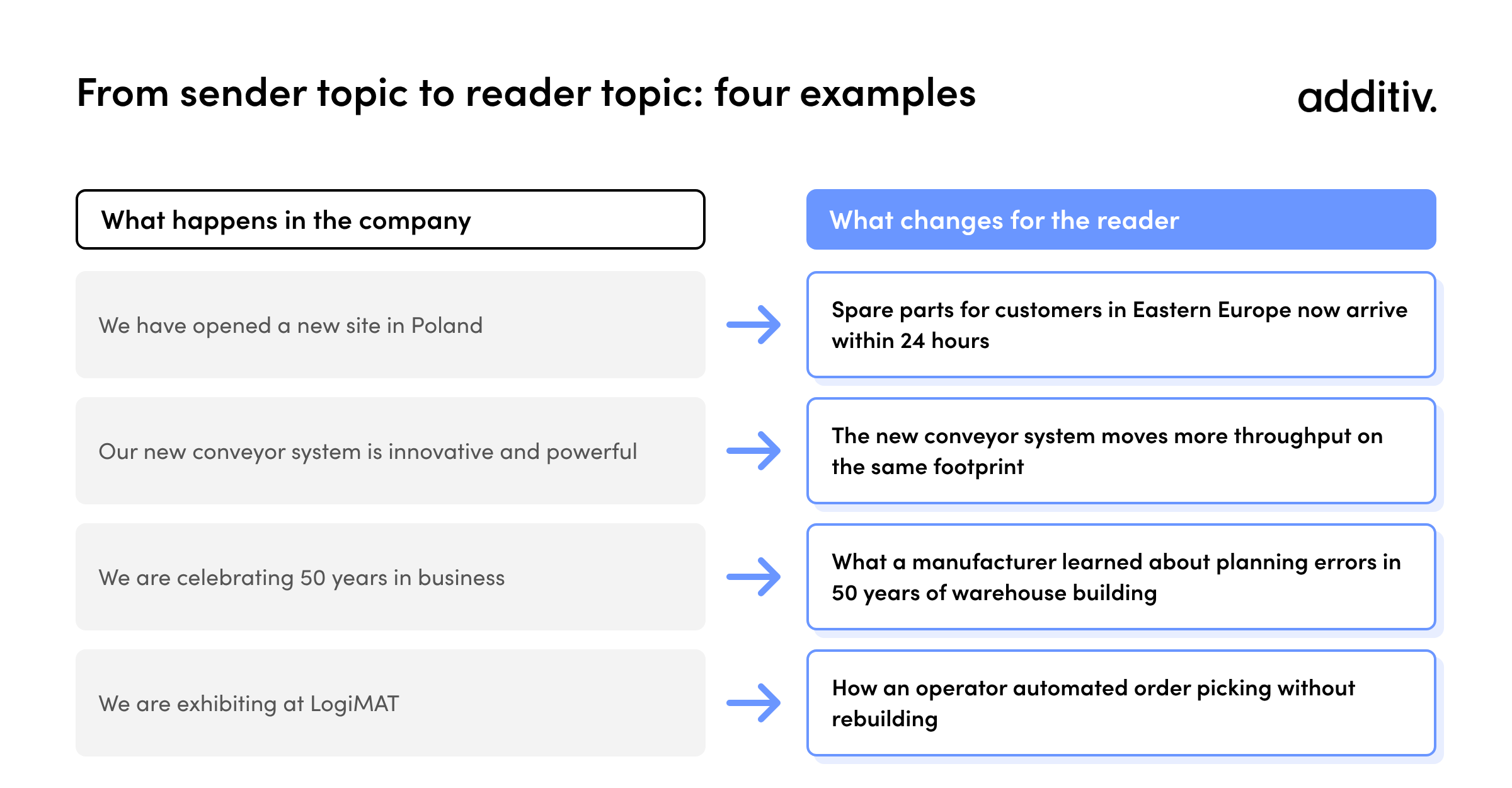
Comparison of four press topics: on the left what happens inside the company, such as a new site, an anniversary or a trade show appearance; on the right the same topics from the reader’s point of view, such as faster spare parts delivery or lessons from planning errors.

The language is advertising. “Innovative,” “leading,” “holistic” and “unique” are claims without proof. Editors cut them. Or they set the release aside right away, because they would have to rewrite the whole thing.

The facts are missing. New conveyor technology without throughput, dimensions, application area and availability can’t be assessed. Trade media readers want numbers. So do the editors.

The benefit is buried at the bottom. Many releases start with the company and end with the result. Editors read it the other way around. The most important point belongs in the headline and the first sentence.

The material is unusable. A 72 dpi product shot, a cut-out rendering with no real environment, no caption, no credit line. No printed magazine can work with that.

The distribution list is too broad. A release that goes to the business press and twenty trade titles at the same time is written for none of them. A trade editor spots that instantly.

The schedule replaces the story. “We send something out every month” is a plan for the sender. In a month with no story, you get a release with no story. After the third of those, the editors stop reading the fourth closely.

Why is your competitor in every other issue?

Competitors who show up in the trade press all the time offer editors more than press releases. That stings when you dutifully send out your release every month and still come up empty. Look at what your competitor delivers instead:

  • Case studies, in which a customer explains what has changed in their operation
  • Bylined articles, in which an expert answers a question many in the industry are asking
  • Experts as sources, whom editors can contact for market overviews and background pieces
  • Topics that match the editorial calendar, pitched in good time

Behind this there’s usually a way of working that doesn’t need a big budget. Someone in the company or at the agency knows the editorial calendars and the people in the newsrooms. That person knows which issue is looking for which topic. The press release then becomes just one tool among several.

Two examples from our work show what this can achieve. For Wiferion, it generated 256 publications in 2025. For Safelog, the count came to more than 676 clippings over three reporting periods, including coverage in Handelsblatt and FAZ.

What works better than a press release?

Finished content that editors don’t have to build themselves works better than a press release, such as a case study or a bylined article. The press release is still the right format for real news. Think of a new product, an acquisition, a major order or a figure the industry cares about. For almost everything else, there are better ways into the magazine.

  • The case study tells the story of a real customer deployment, from the starting point to the result. Quotes and images come from the operation. Trade journals like to print it because readers recognize themselves in it.
  • The bylined article answers a question that goes beyond your product. For example: What matters when planning an automated warehouse? It is often written exclusively for one publication.
  • The editorial meeting brings an expert with a topic to the editors. You don’t need a finished text for it. Interviews and background pieces grow out of it. Often you’re left with a contact that lasts for years.

If you use these formats, you need fewer press releases. And the ones you still send get read more closely, because the editors know you by now.

How do you get your story to the editors?

You get your story to the editors with a personal pitch to the right person at the right time. Above all, that takes preparation. Here’s how to go about it:

  1. Frame the topic from the reader’s point of view. One sentence: What will readers learn that they didn’t know before?
  2. Choose the right media. Five titles whose readers fit exactly beat forty that fit somehow.
  3. Check the editorial calendars. The media kit shows which issue has which focus and when the editorial deadline is.
  4. Find the responsible editor. The masthead or the website lists who covers what. An email to the general newsroom address is the weakest route.
  5. Keep the pitch short. Write three or four sentences on the topic, why it fits now, which format you offer and what material is available. Don’t attach a finished text on first contact.
  6. Have material ready. You need print-quality images with captions and the data. Add a contact person who can be reached.

If the editors say yes, deliver on time and at the agreed length. If they say no, ask why. The answer will help your next pitch more than any checklist.

How can you tell that things are changing?

You can tell things are changing by the coverage you get. The number of releases you send tells you little. Three things are worth watching:

  • How many articles appear and in which media. A case study in a leading industry title carries more weight than ten short items on online portals.
  • What form they take. Do only shortened releases appear, or are full articles and interviews coming out?
  • Whether editors approach you on their own. That is the clearest sign that your company is seen as a source.

And that gives you your answer for management, too. They are right to ask what press relations deliver. A list of publications in the right media answers that better than any mailing statistics.

If you’re looking for support: Our press relations for B2B companies start at exactly this point. For our work for the Open Logistics Foundation, we won the German Agency Award 2026 (Deutscher Agenturpreis) in the “B2B / PR” category.

Frequently asked questions

How often should a company send press releases to the trade press?

As often as there is real news. A fixed monthly schedule leads to releases without a story. Editors then read the sender less carefully. Many mid-sized companies do better with a few strong releases a year. Case studies and bylined articles complement them.

Does an ad help you get editorial coverage?

No. Reputable trade media keep advertising and editorial separate. Section 7 of the German Press Code requires it. Paid formats such as advertorials must be recognizable as advertising. They are no substitute for editorial coverage.

What is the difference between a press release, a bylined article and a case study?

The press release announces news and goes to many media outlets. The bylined article covers a specialist topic beyond your own product and is usually offered to one publication exclusively. The case study describes a specific customer deployment, from the starting point to the result.

How long should a press release for the trade press be?

Short enough for the key message to sit in the first paragraph. Long enough for the technical facts. In practice, one page is usually enough. Further details belong in a data sheet or on a web page the release links to.

Is a press portal worth it if the trade press won’t print your release?

A portal puts the release online. It won’t get it into the magazine. That can help findability. It is no substitute for coverage in a trade journal, because there an editor made the selection. That is exactly what gives it value for readers.

Is it okay to follow up with an editor on whether the release will run?

Yes, once and with a reason. A short follow-up with something extra is welcome. Think of an image from a deployment or a person available for an interview. Repeated chasing without new content does harm.

Why does the trade press shorten press releases?

Because space is limited and editors only keep what matters to their audience. Promotional passages and quotes that say nothing go first. The company description usually follows right after. If you put the key message up front, it survives the shortened version too.
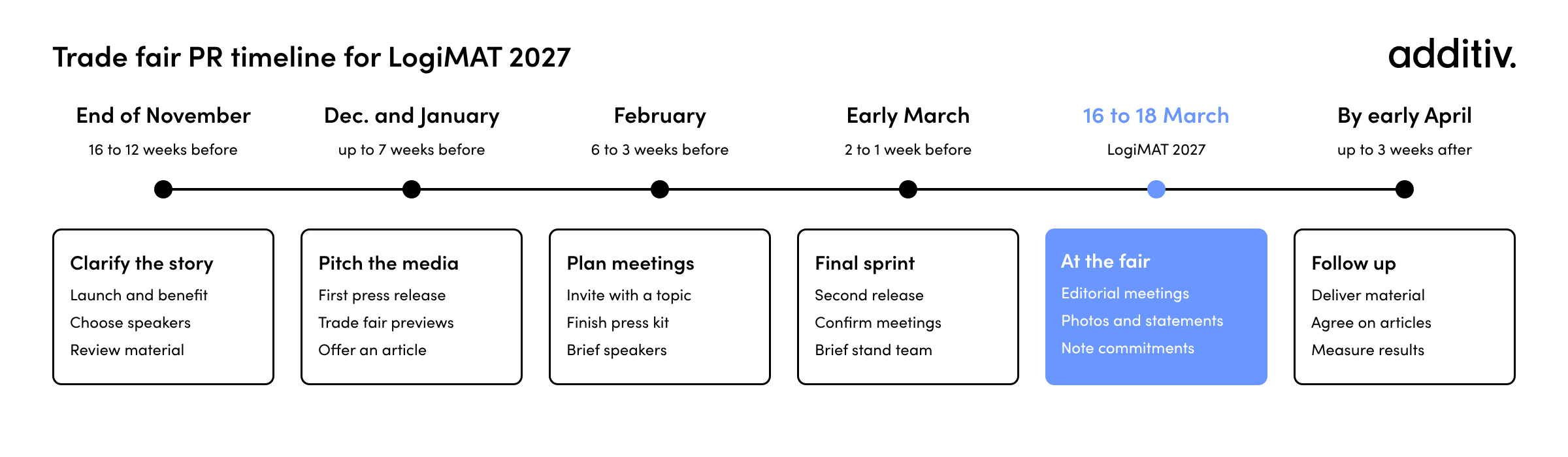
Trade fair PR timeline for LogiMAT 2027: what needs to happen 16 weeks before the show

Your stand for LogiMAT 2027 is booked. Your launch is almost ready. So what about the press work? Start now and your timing is right. Wait until February and you will mostly be reading about other exhibitors in the trade press.

Key points at a glance

  • Press work for LogiMAT 2027 starts at the end of November, around 16 weeks before the fair opens on 16 March.
  • By Christmas, your story and your material are in place.
  • The first press release goes to the trade media in December or January, so your launch makes it into the show previews.
  • February is the month for personal invitations to editorial meetings at your stand.
  • In the three weeks after the fair, you follow up so that conversations turn into published articles.
  • Start only in February and you will often miss the previews.

Why do so many LogiMAT exhibitors get so little press coverage?

So many LogiMAT exhibitors get so little press coverage because their press work starts too late. Sound familiar? Stands and exhibits are planned for months. The press release, by contrast, often gets written in the final two weeks. For many editorial teams, that is too late. Their show previews are usually planned by then. Many of their meeting slots are already taken.

Plenty of marketing managers in intralogistics know what happens next. The stand is busy. Most visitors, however, are passers-by and competitors. The company does not appear in the trade media. And in April you sit across from management, looking for a good answer to the question of what the fair delivered.

Yet LogiMAT is an important stage for intralogistics. Trade journalists arrive at the Stuttgart exhibition centre with a clear brief: find new products and gather stories for the months ahead. If you gave them a topic in advance, you are on their list. If you hope to catch their eye at the stand, you are relying on luck. How many releases you send hardly matters. What counts is whether an editor sees why your launch is relevant to their readers.

When should press work for LogiMAT 2027 start?

Press work for LogiMAT 2027 should start at the end of November 2026. That sounds early. But it is exactly the lead time the trade media need. LogiMAT 2027 runs from 16 to 18 March 2027 in Stuttgart. Counting back from the opening day, press work needs around 16 weeks:

  • four weeks for the story and material, until shortly before Christmas
  • two weeks off over the holidays
  • four weeks for the press release and the previews, mainly in January
  • four weeks for invitations and scheduling, in February
  • two weeks for the final run-up to the fair, in early March

That does not leave much slack, especially with the holidays right in the middle. Trade magazines plan the topics for their show previews several weeks before publication. The exact editorial deadline is listed in each title’s media kit. So checking it is a job for week one.

What does the timeline up to the fair look like?

The timeline up to the fair follows a simple logic: the story comes first, then the media. Meetings build on both. Sounds obvious? In the run-up to a fair, it often works the other way round. The date for the press release gets fixed first. The story is made to fit afterwards.

Trade fair PR timeline for LogiMAT 2027 from 16 weeks before the fair: story and material by Christmas, first press release in December or January, stand meeting invitations in February, follow-up up to three weeks after the fair

End of November to Christmas (16 to 12 weeks before): clarify the story

  • What are you launching? Why does it matter to companies that run warehouses and production?
  • Who speaks for the company? Ideally someone from engineering or management who is comfortable talking to journalists.
  • What material do you already have? Think images, data, application examples or a customer willing to talk.
  • Check whether to enter the launch for the LogiMAT “Best Product” award. The organiser publishes the conditions and the submission deadline.

December and January (up to 7 weeks before): pitch the trade media

  • Send the first press release on the launch to the trade media, with images and technical data.
  • Check the media kits for preview issues and offer topics that fit them.
  • Where it makes sense, offer a technical article for publication after the fair.

February (6 to 3 weeks before): schedule meetings

  • Send personal invitations to editorial meetings at the stand, each with a topic.
  • Finalise the press kit, in digital form and in print for the stand.
  • Prepare your speakers with key messages and the three most likely questions.

Early March (2 to 1 week before): final run-up

  • Issue a second press release if there is news, such as a premiere or a customer.
  • Confirm meetings and brief the stand team. Who receives journalists? Where can you talk undisturbed?
  • Prepare LinkedIn posts for the fair.

16 to 18 March 2027: at the fair

  • Hold the editorial meetings. Capture photos and short video statements.
  • Note who promised what and who asked for what.

Until early April (up to 3 weeks after): follow up

  • Deliver the promised material and agree on articles. Approve interviews.
  • Collect the coverage and evaluate it.

What belongs in a LogiMAT press kit?

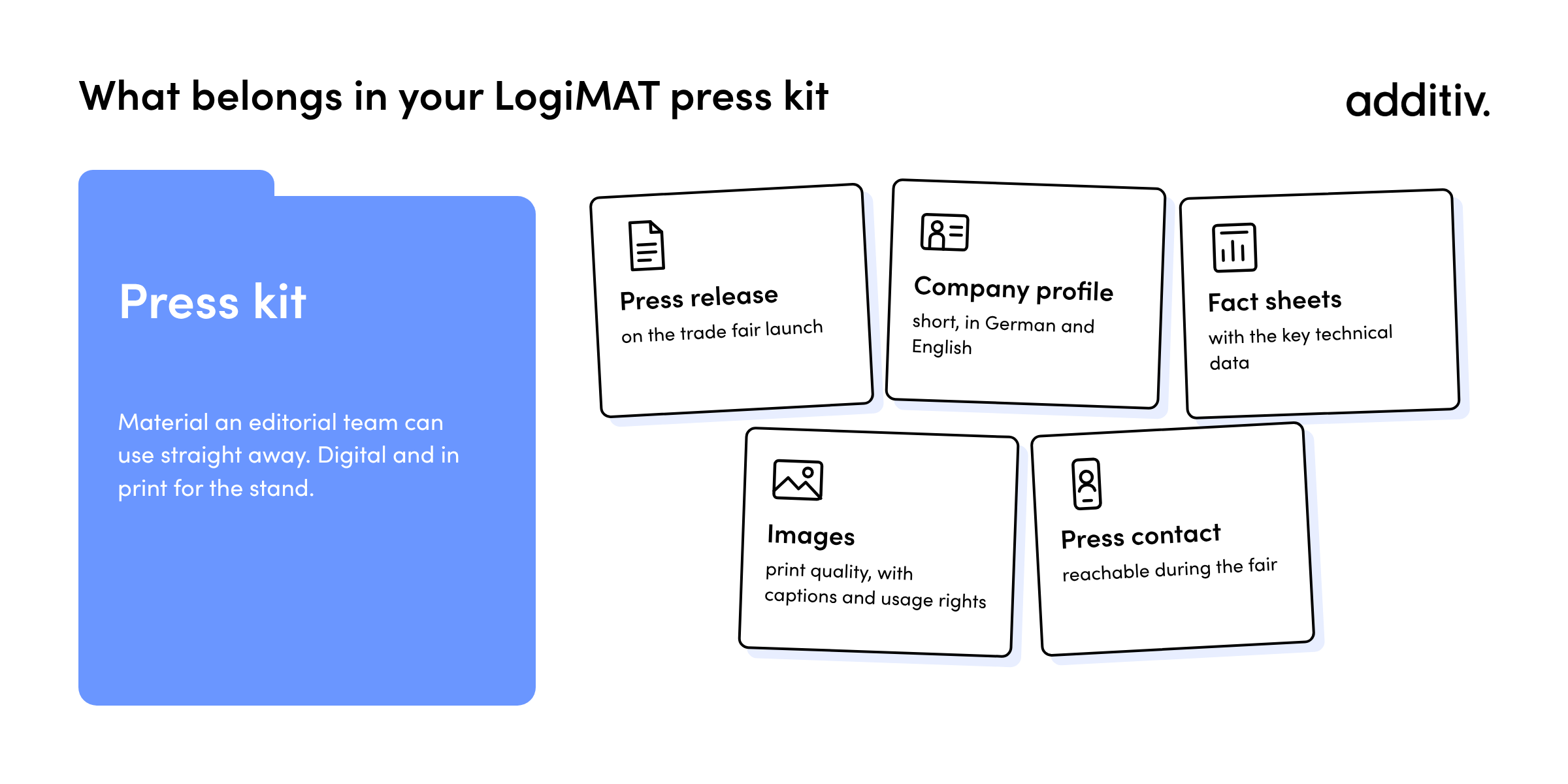
Above all, a LogiMAT press kit needs material an editorial team can use straight away. Picture the editor who stops by your stand on day two, between two appointments. She wants to pick up what she needs for her article in a few minutes. That means:

  • the current press release on your launch
  • a short company profile in German and English
  • one or two product fact sheets with the key technical data
  • print-quality product images and portraits of your speakers, with captions and usage rights
  • a press contact with a phone number who can also be reached during the fair

Online, the kit should have its own page on your website so that journalists can find it before and after the fair.

LogiMAT press kit with five components: press release on the launch, short company profile in German and English, fact sheets with technical data, print-quality images with usage rights, press contact during the fair

How do you get editorial meetings at your stand?

You get editorial meetings at your stand by offering a concrete topic, not an invitation to drop by. In February, every editorial team receives dozens of emails that say “Visit us at LogiMAT”. At the fair itself, editors usually have little time and receive many requests. A meeting happens when it is clear what you will discuss and why it matters to their readers.

Here is how to go about it:

  • invite the responsible editor personally by email
  • name a concrete topic, such as the launch or a customer application
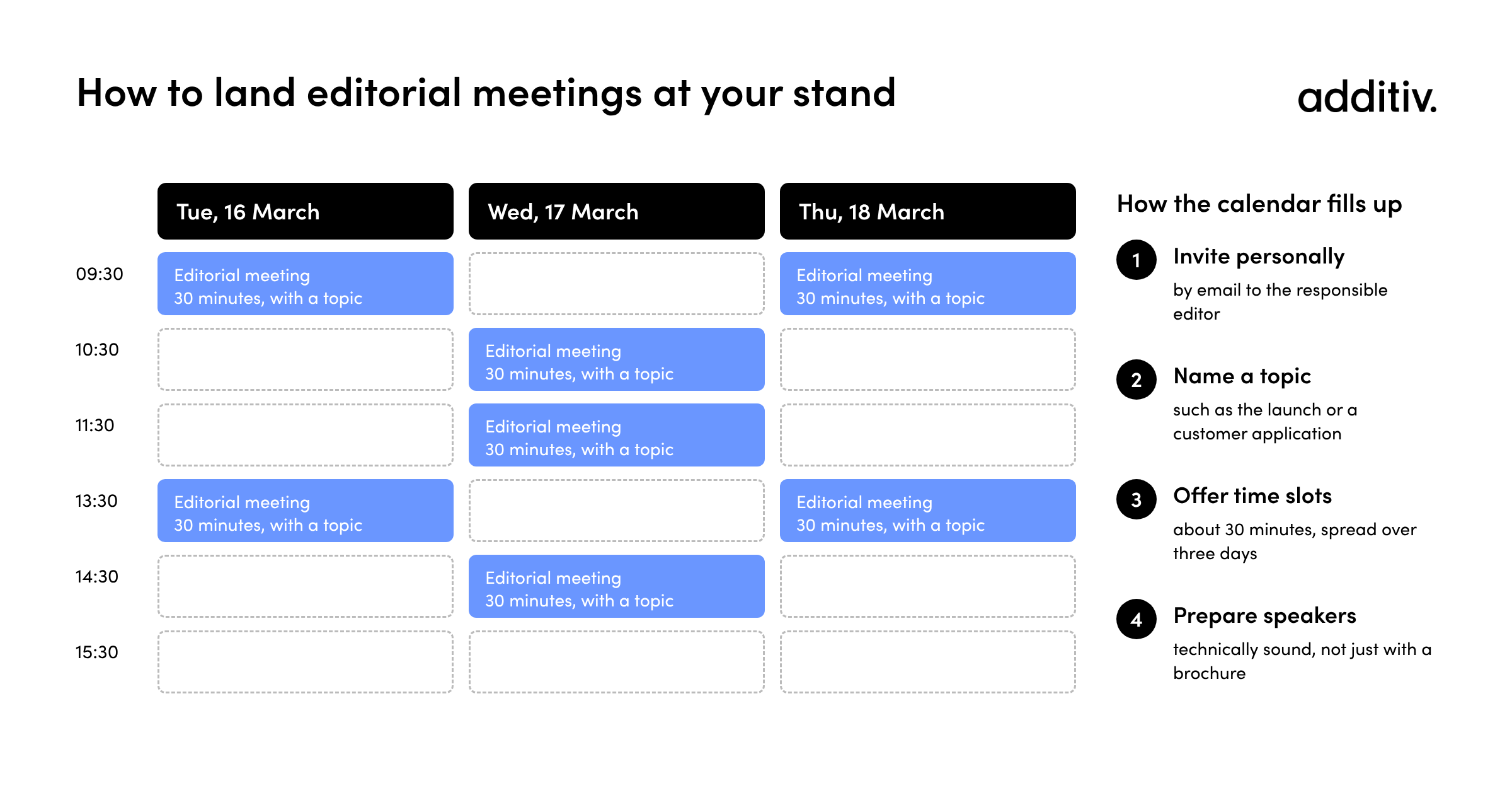
  • offer fixed slots of around 30 minutes spread across the three days of the fair
  • prepare speakers who can answer technical questions

A press conference only pays off for a launch with genuine news value. For most exhibitors, one-to-one meetings achieve more because each editorial team gets its own angle. For smaller marketing teams, individual meetings are also easier to manage than one big event.

LogiMAT calendar from 16 to 18 March with 30-minute editorial meetings spread over three days, next to four steps: invite personally, name a topic, offer time slots, prepare speakers

Which trade media matter for LogiMAT?

For LogiMAT, the key German trade titles in intralogistics include LOGISTIK HEUTE, DVZ, MM LOGISTIK, f+h and dhf Intralogistik. For conveyor technology and cranes, Hebezeuge Fördermittel completes the list. Depending on the topic, titles covering production or automation come into play. For software topics, the same applies to IT media. Choose your titles by whose readers match your launch most closely.

Do you also sell internationally? Then you need an English press release as well. LogiMAT draws trade visitors from many countries. International media also cover the fair. A good translation is usually not enough. Technical terms and number formats have to suit English-speaking readers. The same goes for the examples.

What happens after the fair?

Press work carries on after the fair. Much of the coverage only appears in the following weeks as follow-up reports, technical articles, interviews and case studies. This is exactly where many exhibitors give away what they worked for at the stand. The crates are barely unpacked when day-to-day business takes over. The business cards stay in a pile.

Three things decide whether conversations turn into articles:

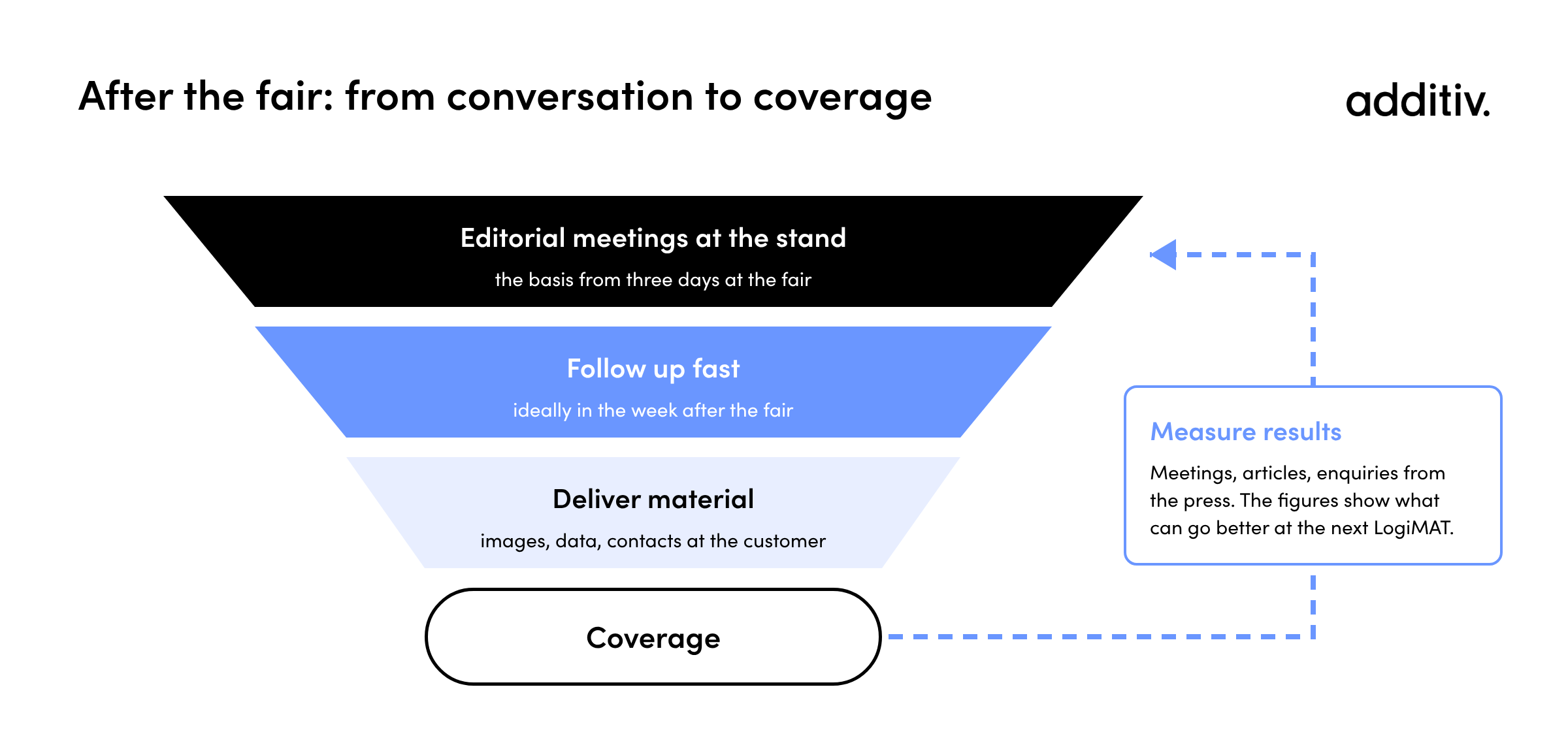
  • follow up, ideally in the week after the fair
  • deliver promised material such as images or contacts at the customer
  • measure the results: how many articles came out of the editorial meetings? Which enquiries came in through the press?

These figures are the best answer when management asks what the fair delivered. You walk into that meeting with a list rather than a gut feeling. The figures also show where the next LogiMAT can go better.

Funnel after LogiMAT from editorial meetings at the stand through fast follow-up and delivered images and data to coverage, with measuring results as feedback for the next fair

Is your team already stretched by the stand and the exhibits? If you are an international exhibitor and would rather not handle LogiMAT press work on your own, take a look at our packages under PR for LogiMAT 2027 exhibitors.

Frequently asked questions

Is one press release in the week of the fair enough?

No, a release sent during show week usually gets lost. By that point, editors have generally mapped out their LogiMAT reporting. They are also flooded with announcements from other exhibitors. December or January is the better moment, while the preview issues are being written.

Is a press conference at LogiMAT worth it?

A press conference at LogiMAT is usually worthwhile only when your launch is real news. It competes for attention with plenty of other appointments. To meet several editors at once, invite them to a small briefing at your own stand instead.

Do I need a press release in English?

An English version of your release is essential if you sell abroad or want to reach visitors from outside Germany. Send it out on the same day as the German version. Many international trade titles also plan their show coverage well ahead.

How long should a trade fair press release be?

A trade fair press release should run to around 2,000 to 3,000 characters. That leaves room for the launch, its benefit, the key figures and a quote. Anything more detailed goes in the fact sheet.

How much lead time do stand meetings with editors need?

Invitations for meetings with editors at your stand should go out three to six weeks before LogiMAT opens. Sent too early, they are forgotten by the time the show starts. Sent too late, they land in calendars that are already full.

How do I measure the success of trade fair PR?

You measure trade fair PR by the meetings you held with editors and by what they publish in the weeks that follow. Enquiries generated by press coverage count as well. Reach figures alone say little about whether you got through to the right audience.

What should I post on LinkedIn around the fair?

On LinkedIn, the strongest posts follow the fair from the first preview to the final round-up. Beforehand, give a glimpse of your preparations and the launch. During the show, short posts from the stand work well. Afterwards, sum up the conversations that mattered most. LinkedIn supports your press work without replacing it.

Logistics? Going strong! Our PR work for OLF wins the Deutscher Agenturpreis 2026

Open Logistics, open Champagne! We are popping the corks: additiv is among the winners of the Deutscher Agenturpreis (German Agency Award) 2026. Our case for the Open Logistics Foundation (OLF) won in the B2B / PR category.

With this award, the jury recognises a story that demonstrates what earned media, thought leadership and a clear core messaging framework can achieve: together, they turned the OLF from a well-kept secret into the voice of the logistics sector, despite a topic that is difficult to explain. This neutral, industry-driven foundation advocates for uniform, open standards in a sector where consignment notes and CO₂ data are still often handled on paper or in siloed systems. After more than three years of collaboration, the OLF is increasingly the name people associate with eCMR, eFTI and open-source standards.

We are delighted to have been part of this year’s Deutscher Agenturpreis and would like to offer our warmest congratulations to all the other winners. A big thank you goes to the Open Logistics Foundation for its trust, the collaboration and the exciting projects still to come. And of course, to the team that made this case possible.

Explaining technical content clearly: 5 tips for corporate influencers

Technical topics are often complex. Communicating them doesn’t have to be. Corporate influencers show how to frame and tell specialist knowledge so that it stays precise and gives readers relevant orientation. Told well, it also sparks conversation. Five tips help: establish context, define one core message, follow a clear writing structure, split large topics and explain technical terms and figures.

PLC, OEE, MES, OPC UA. Lost you already? A technical post can be accurate and still miss its audience. This happens above all when it opens with product features, abbreviations, process details or technical metrics before it is clear why this information matters at all. To experts, the connections may be obvious. Everyone else is left with one question: what’s in it for me?

This is where corporate influencers take on an important role as translators: they put specialist knowledge into the context of their audience.

Corporate influencers as translators of specialist knowledge

Corporate influencers know more than the technical connections. They often also know the questions these raise in everyday work with projects and customers or across the industry. This closeness to practice is their strength. They can explain where a topic actually becomes relevant and which challenges come with it. They also know what matters in the solution.

A clear post sets one focus, for example a specific problem or a change in day-to-day work. An insight from practice works just as well. Technical expertise provides the foundation. Your own perspective frames the topic so that readers can understand and discuss it.

This way, the corporate influencer avoids sounding like an advertising channel or a technical data sheet. Five tips help them give their audience reliable orientation in a complex technical field.

1. Establish context: how technical content becomes relevant

The first rule when you translate technical content into language your audience understands: establish context. Even a precisely described fact needs a connection your readers can follow. There are different angles you can take:

  • What problem lies behind a technical development?
  • Why is the topic relevant right now?
  • What changes as a result in day-to-day work or for customers and the industry?
  • What follows from it?

Important: you don’t have to work through these questions in every post. A LinkedIn post gains clarity when it pursues exactly one central message. Trying to answer several questions and thoughts at once blurs that message.

Making content understandable still means keeping the specialist substance and the decisive details. Technical expertise remains the basis of credibility. The angle shifts, though: alongside the question of how a solution works, its meaning for the audience moves to the front.

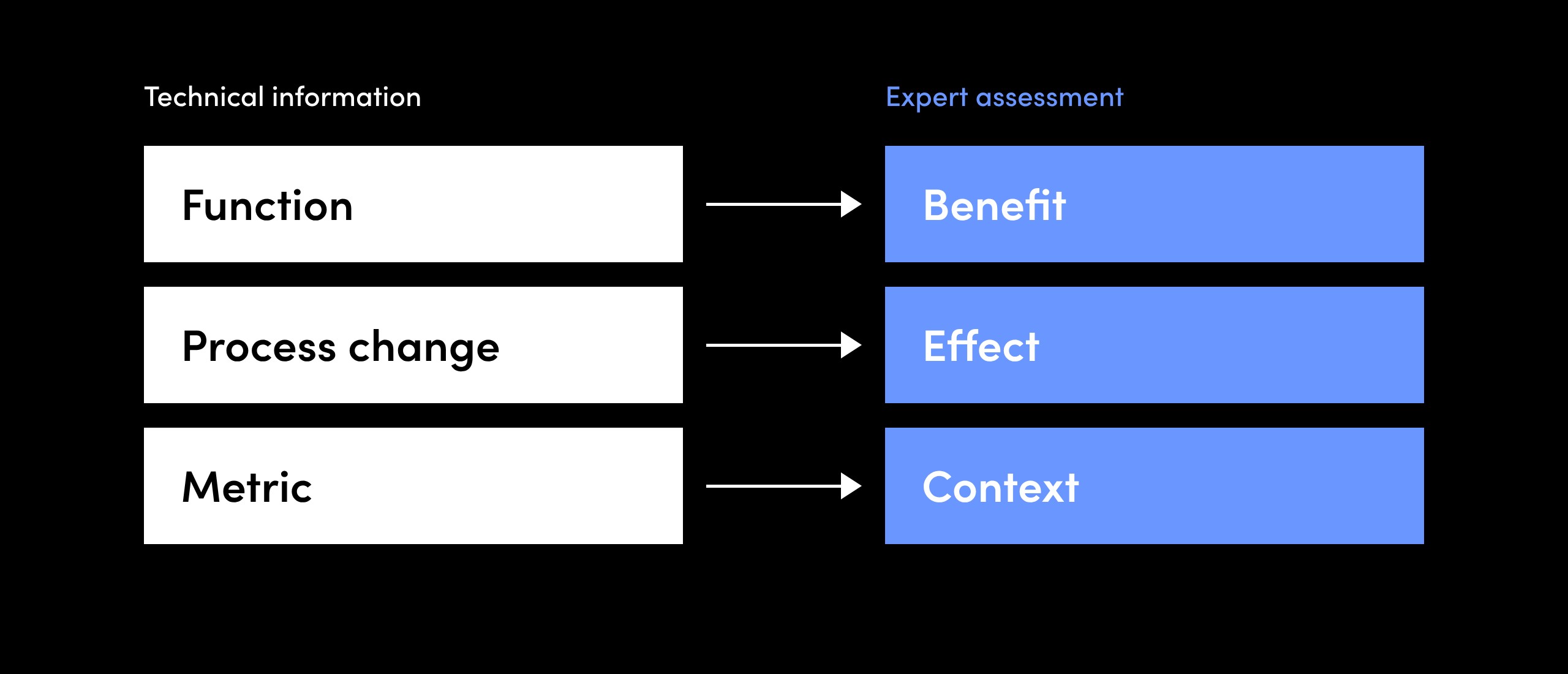
This turns a piece of technical information into an expert assessment. Functions are linked to their benefit, and process changes become tangible through their effects. Metrics are explained in the right context.

Diagram: technical information becomes expert assessment, function becomes benefit, process change becomes effect, metric becomes context

2. From technical topic to core message

Before you write a technical LinkedIn post, a short editorial step pays off: narrow down the topic. You should be clear about who the post is for and what this audience should take away from it. On this basis, you can pick the relevant technical details and leave out everything that does not support the core message.

A simple rule of thumb shows whether the focus is sharp enough. Can you state the core message in one sentence? If not, the topic may still be too broad. A guiding question can sharpen the focus further, for example on a concrete problem or a practical effect. An insight from a project can also serve as the anchor. Here too, not every aspect has to fit into the post. A clear focus usually has more impact than an attempt to cover a topic completely.

Your own expert perspective matters just as much. Which observation or experience lies behind the message? Your view can stay measured, as long as it makes clear how you arrived at your assessment. This gives the post a solid framework.

3. The writing structure for technical LinkedIn posts

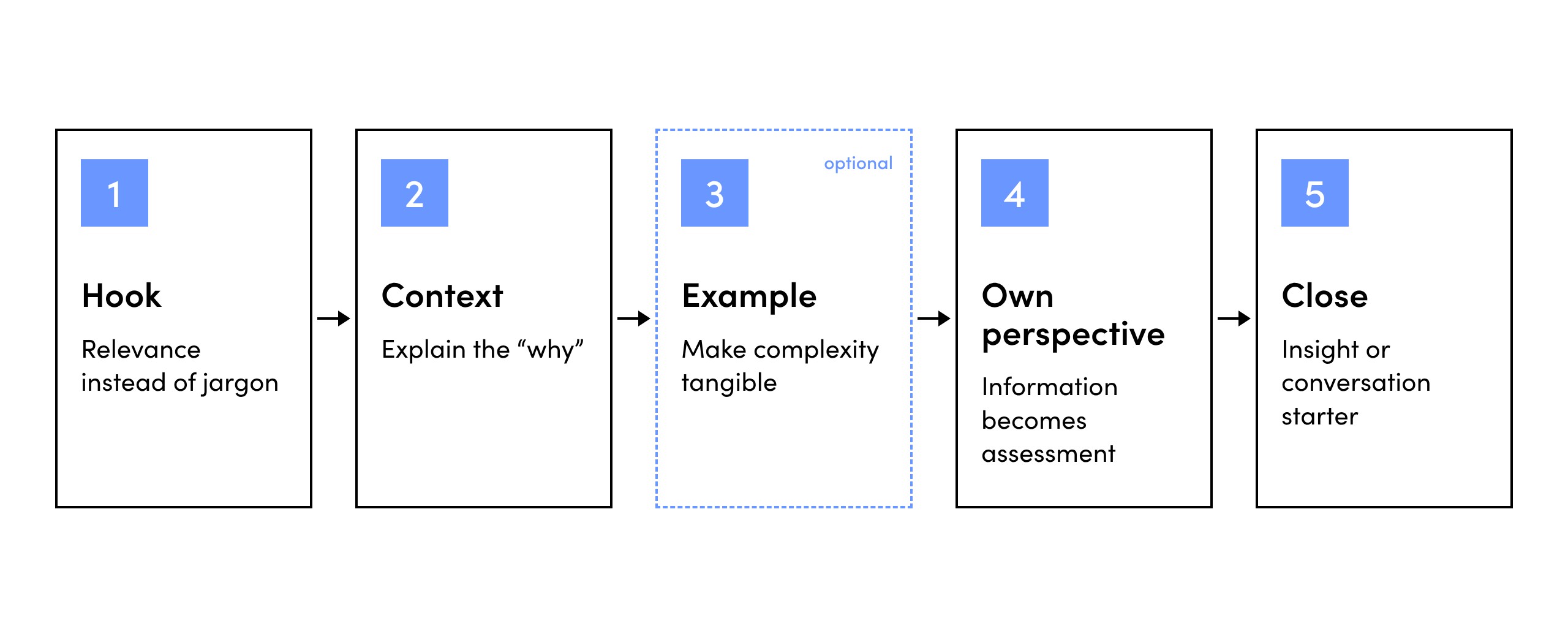
A clear storyline helps you get technical content to the point. A framework of hook, context, example, own perspective and close works well for this.

Writing structure for technical LinkedIn posts in five steps: hook, context, example (optional), own perspective, close

Hook: relevance instead of jargon

An opening built on an observation or a question usually sparks more interest than a technical definition. A concrete challenge works well too. The hook should make readers curious and match the content. A sharp statement only convinces if the post then delivers on it.

Context: explain the “why”

Sketch the starting point briefly: why is the topic relevant now? This gives readers enough orientation without the post drifting into technical detail.

Example: make complexity tangible

A case from day-to-day work or a typical question from practice can make abstract connections easier to grasp. An observation from a project does the same. The example should illustrate the central message and keep to a single story. If there is no suitable example, you can skip this step.

Own perspective: information becomes assessment

Your own assessment follows from the context or the example: what does the case show? What do you find remarkable about it? A concrete observation or a reasoned evaluation gives the post a profile. It also shows the value the post adds beyond pure information.

Close: insight or conversation starter

The close can sum up the thought concisely or name the consequence. If the post is meant to spark discussion, ask a concrete question that ties in with readers’ own experience.

4. When a topic is too big: split it up instead of overloading

Some technical topics contain several insights or challenges, often with lessons learned on top. Packed into one LinkedIn post, they compete for attention. The central message easily gets lost. In that case, it makes more sense to split the material.

A series of posts could, for example, start with the initial problem and then explain the solution or approach. A final post puts the experience gained into perspective. Each post needs its own single focus and has to make sense on its own. In other words, every post must be able to stand alone.

5. Explain technical terms and figures clearly

A technical term that belongs to a topic does not automatically add value for readers. If they need it to follow the post, introduce it at the point where it comes up and explain it briefly. Spell out abbreviations on first mention unless they are widely known.

Figures need context too. A measured value or a percentage says little on its own. Readers need the comparison behind it and the change it shows. And what does it mean in practice? A short explanation makes the value understandable without overloading the post with additional detail.

Conclusion: specialist knowledge that reaches its audience

Telling technical content clearly as a corporate influencer comes down to the essentials: the right context and a clear message. Both need an assessment readers can follow. This turns specialist knowledge into a post that does more than inform: it gains meaning for its audience.

The Corporate Influencer Playbook by additiv (available in German) shows how corporate influencers build their own expert voice step by step. For programmes with several experts in your company, additiv works with you as a social media agency for industrial B2B companies.

Checklist: how to translate technical content for your audience

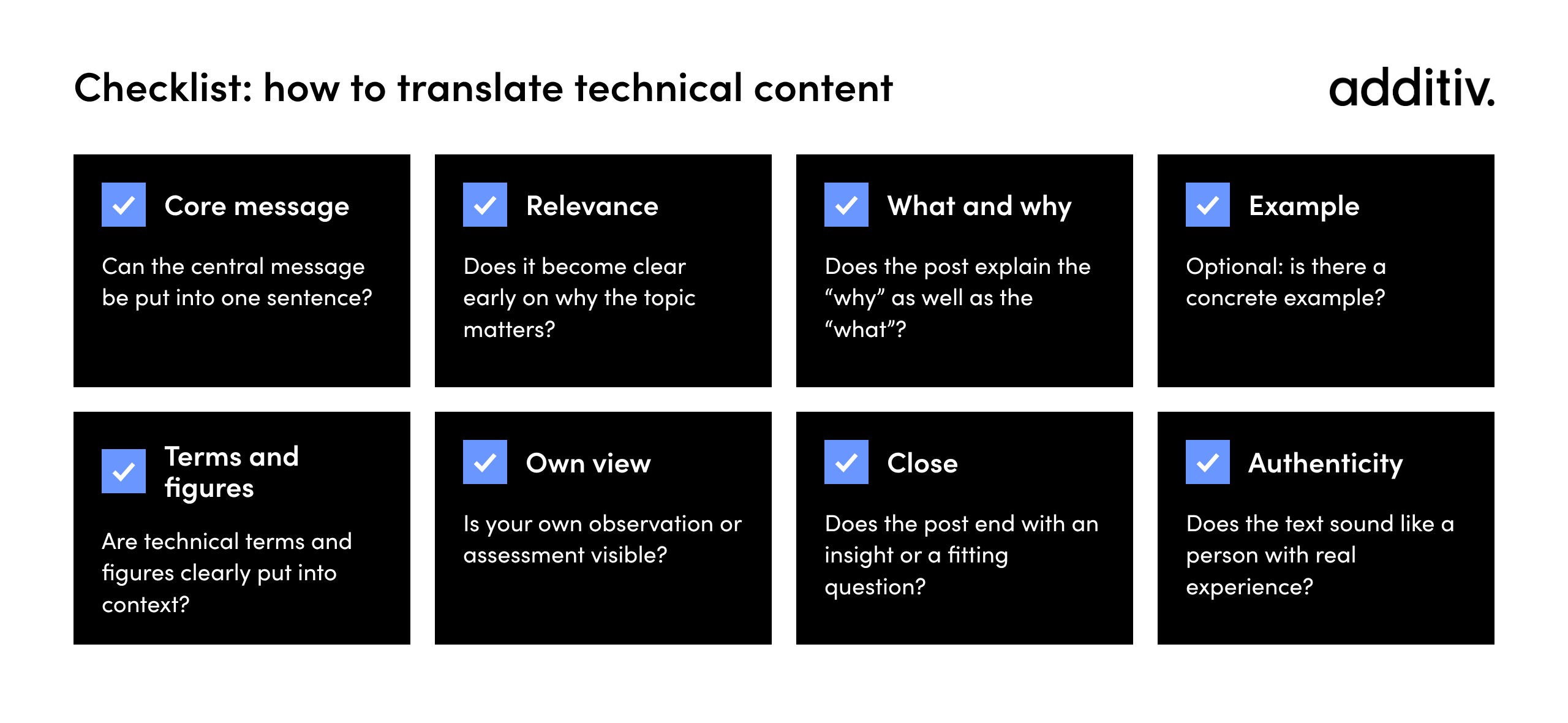
Checklist for technical LinkedIn posts: core message in one sentence, early relevance, the why as well as the what, optional example, terms and figures explained, own assessment, insight or question at the end, real experience

Frequently asked questions about technical content for corporate influencers

What does it mean to translate technical content for LinkedIn?

It means keeping the specialist knowledge correct while telling it from the reader’s benefit. The post opens with the question your readers are asking themselves. Abbreviations and data sheet values come later, and only where they support the message.

Why are corporate influencers particularly suited to technical topics?

They work close to machines and customer conversations, so they know which questions really come up in practice. That makes their assessment credible. Qlar, a specialist in weighing and dosing technology, relies on its sales experts for this. They share personal insights on LinkedIn. In meetings and at trade fairs, people approach them about their posts.

Do technical terms have to be avoided in LinkedIn posts altogether?

No. A technical term can stay if the message cannot do without it. The audience decides: among automation specialists, OPC UA needs no explanation. If purchasing or management also read along, a short clause on its meaning helps.

How do I find a good topic for a technical post?

Start with the questions people ask again and again in daily work. What did customers want to know recently? Where do projects regularly get stuck? Observations like these lead to topics where your own experience adds something.

Should management and engineering also act as corporate influencers?

Yes, as long as they have something to put into perspective. Management can explain market developments and strategic decisions. Engineering teams show how a solution came about. A coordinated division of roles makes sure the topics of several voices complement each other.

How can I tell whether my technical post is easy to understand?

Eight questions help before you publish. Does the core message fit into one sentence? Does the opening show the relevance? Does the text explain the why as well as the what? Is there an example, where it fits? Are technical terms and figures explained? Is your own assessment visible? Does the text end with an insight or a question? Does it sound like real experience? A simple test: ask a colleague from another field to sum up the draft in one sentence.

Can AI help translate technical content?

Yes, with the wording. AI assistants such as ChatGPT or Claude simplify drafts and spell out abbreviations. They can also suggest alternative openings. The assessment from your own project experience and the technical review stay with the person who publishes the post.

How does additiv support corporate influencers in technical companies?

additiv helps industrial companies build corporate influencer programmes. At Qlar, workshops produced pragmatic guidelines with dos and don’ts that the experts use to create their own content. Our post on the LinkedIn profile for corporate influencers shows what the matching profile looks like.

First impressions count: how your LinkedIn profile becomes a strong business card for corporate influencers

A substantive LinkedIn post can attract attention. But one click on the profile shows whether anything more comes of it: do visitors see straight away who is speaking, what the person stands for and what long-term value their posts offer? For corporate influencers in particular, clear positioning is therefore essential. Five elements shape that first impression: profile photo, banner, headline, About section and Featured section.

Stay and keep browsing, or click away? When that question comes up, many people first take a look at the LinkedIn profile. What is often underestimated is that the profile is far more than a digital CV. As a personal business card, it provides the context for your own posts, comments and conversations. It also lays the foundation for a recognisable expert voice.

A generic job title, an outdated photo and no hint of topics, stance or added value quickly make the first impression fizzle out. A coherent profile shows at first glance what sets a person apart, what they talk about and which company they are connected with.

The key question for any profile check is therefore:

Would someone recognise from my profile alone what I stand for and which company I represent?

If the answer is not clear, it is time to revise your profile.

The LinkedIn profile as the basis for credibility and thought leadership

People trust people more than they trust logos. Corporate influencing thrives on employees who keep bringing their expertise into relevant discussions, share their experience and remain visible as personalities. This gives the company an expert voice with a stance of its own, distinct from interchangeable brand messages. The aim is long-term credibility, trust and thought leadership. Short-term reach is secondary.

Anyone taking on this role should therefore first clarify:

  • What expertise do I bring?
  • On which topics do I want to offer orientation?
  • And how is my contribution connected to the company?

A good LinkedIn profile therefore has to do two things at once:

  1. It has to make the person recognisable as a credible expert voice.
  2. It has to make the link to the company clear without looking like an advertising channel.

Five elements for a strong first impression

A corporate influencer profile wins people over with the interplay of image, visual framing, positioning, personality and concrete proof.

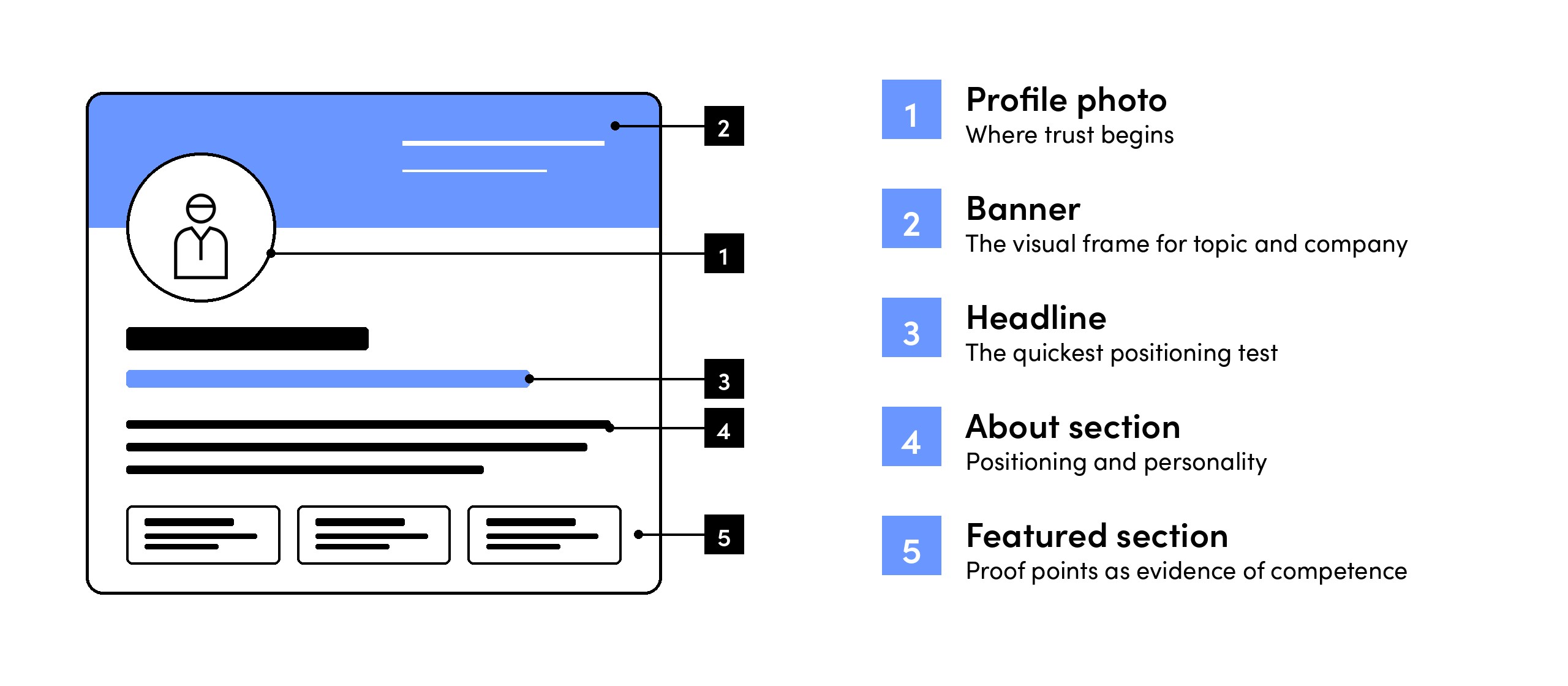
Five elements of a strong corporate influencer profile on LinkedIn: profile photo, banner, headline, About section and Featured section, additiv

1. The profile photo: presence, professionalism and personality

The profile photo is where trust begins. It should be professional and up to date, show personality and suit the role. A clear, high-quality photo with a fitting expression therefore works better than an interchangeable application photo. It supports the impression that posts and comments convey, without having to explain the positioning.

2. The banner: the visual frame for topic and company

The banner on a LinkedIn profile sets the visual frame for the positioning. A suitable motif, a short thematic statement or a pared-back style can show at a glance which industry, topic or company context the person is connected with.

Less is often more here: a banner full of claims, logos and buzzwords quickly looks like advertising. A clear thematic focus with a discreet reference to the company strengthens the personal positioning.

3. The headline: the quickest positioning test

The profile headline is the quickest positioning test on LinkedIn. It appears not only on the profile but also next to posts and comments and in search results. “Managing Director at Company XY” describes the function, but says nothing about why anyone should follow this corporate influencer on LinkedIn.

A good headline therefore sums up what the person stands for professionally, which topics they put into context, which perspective they take and what others can expect from their content. The full career belongs elsewhere in the profile. The headline should create a clear expectation that the profile and the posts then fulfil.

Quite a lot for one line? Don’t worry: the headline is only the opening. In just a few words, it makes people curious about the content to come.

4. The About section: positioning and personality

The About section goes one step further and provides the context behind this first impression. In a few sentences on their LinkedIn profile, a corporate influencer can show where their expertise comes from and which experience and stance shape them. They can also show what makes them who they are as a person.

A professional focus can still sound personal. Interests and hobbies can show who is behind the expertise. Sometimes they build a natural bridge to the core topic. For example, anyone who talks about artificial intelligence and enjoys gaming can draw exciting insights from it.

5. Featured section and proof points: evidence of competence

In the Featured section of their LinkedIn profile, a person can back up their positioning as a corporate influencer with concrete evidence. A few carefully chosen pieces they have already contributed to the topic are enough. Examples include a strong expert article, an interview, a case reference, a talk, a publication or a hands-on project.

The section works best when it stays selective. Every proof point should make the professional competence tangible and fit the profile.

Showing the company link without becoming an advertising channel

A good LinkedIn profile for corporate influencing makes the connection between person and company visible without turning into a constant sales pitch. Role, banner, projects and concrete practical experience are often enough to establish the link. The profile only becomes credible when the person does more than repeat corporate claims. They put topics from their working day into context, show a stance and engage with the community. That way they remain an independent expert voice as a corporate influencer and make the company visible at the same time.

In a profile check, the key question is therefore: “Is it clear what independent contribution this person makes to the professional discourse as a corporate influencer?”

Conclusion: corporate influencing starts with a clear profile

A LinkedIn profile can still be a work in progress when corporate influencing starts. It should already show at a glance who is speaking, what the person stands for and how they are connected to their company.

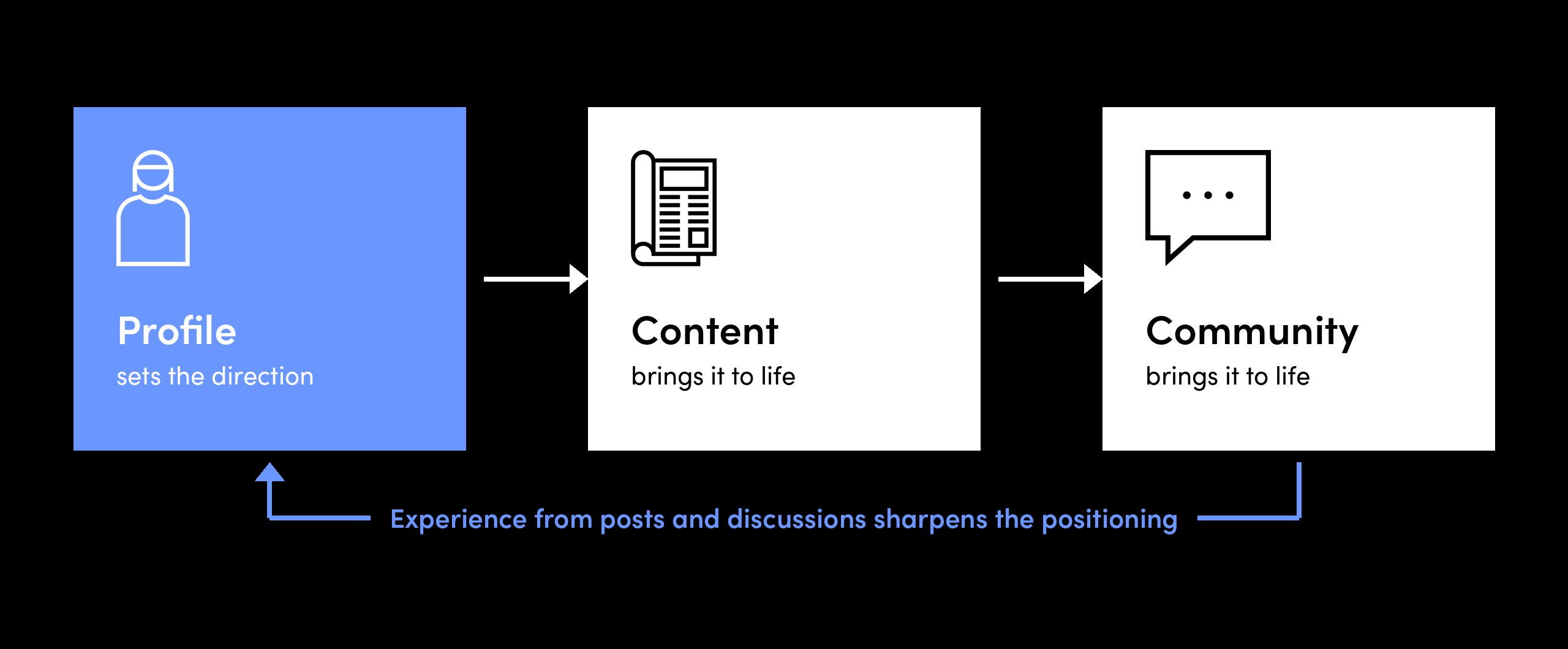
Clarity, focus, personality and concrete proof make the difference, with no need for glossy polish or advertising language. The profile only reaches its full impact together with content and interaction. It sets the direction, and content and community work bring it to life. In turn, experience from posts and discussions shows where the positioning can be sharpened. If topics or your own role evolve, your profile should grow with them.

The profile sets the direction, content and community bring it to life, and experience from posts sharpens the positioning, additiv

Corporate influencing is a long-term undertaking. A credible voice emerges through continuity, relevant content and genuine dialogue. If the first impression still holds up at second glance, the most important foundation has already been laid.

In five steps, additiv’s Corporate Influencer Playbook (in German) shows how profile, positioning, content and interaction work together. When you build your own corporate influencer programme, additiv supports you as a B2B social media agency for industry.

Compact profile check for corporate influencers

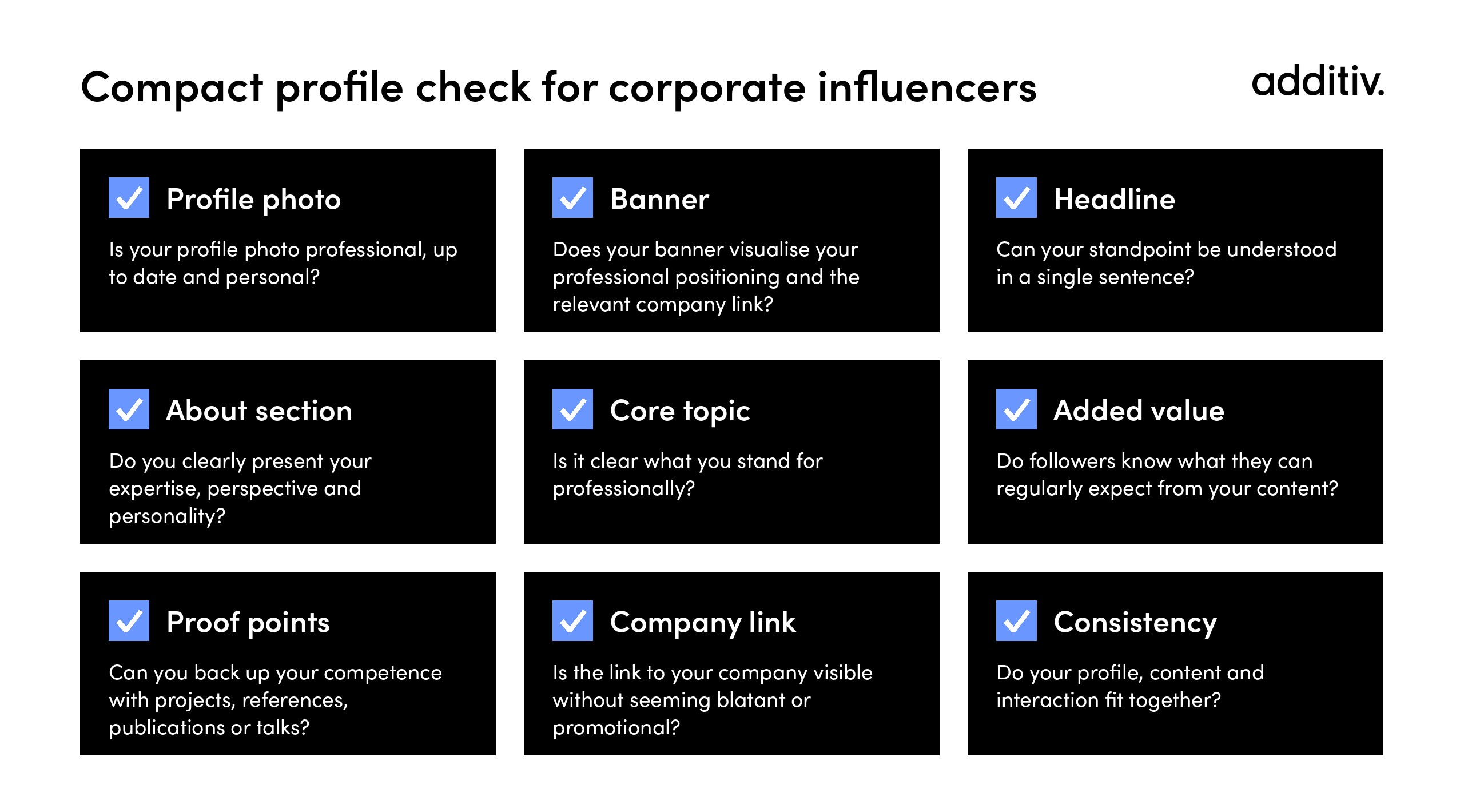
Compact profile check for corporate influencers in nine questions on profile photo, banner, headline, About section, core topic, added value, proof points, company link and consistency, additiv

If you can answer these questions convincingly, you have laid the most important foundation for a strong first impression and a credible corporate influencer presence.

Frequently asked questions about the LinkedIn profile for corporate influencers

What belongs in a good LinkedIn profile for corporate influencers?

Five building blocks carry a corporate influencer profile on LinkedIn. The profile photo and banner set the visual frame. The headline delivers the positioning in short form. The About section adds context. The Featured section proves competence with selected content. Together they make clear within seconds which topic and which company the person speaks for.

How do I recognise a good LinkedIn headline?

A good headline combines role and topic in a single line. It shows which perspective the person takes and what value their posts offer. A bare job title cannot do that. Because LinkedIn displays the headline next to the name almost everywhere, it comes into play with every contact.

How do I show the link to my company without sounding promotional?

The company link belongs in the profile, but subtly. The role, a discreet reference in the banner and real projects are usually enough. It becomes convincing when you speak from your own experience and respond to comments.

Can personal interests go into the LinkedIn profile?

Yes. Hobbies and interests make the person behind the expertise visible. Sometimes they connect directly to the core topic. For example, an AI expert with a passion for video games can describe how AI opponents in a game differ from human opponents. Such a link is optional. Often it is enough to come across as approachable.

Does the profile have to be perfect before corporate influencing starts?

No. At the start, visitors should see immediately who is speaking and what they stand for. The fine-tuning comes with practice. Which topics resonate only becomes clear in posts and discussions. The positioning can then be adjusted accordingly.

How often should corporate influencers post on LinkedIn?

A fixed weekly post prepared in advance has proven its worth. Add to that a reserved time slot for a topical subject. Comments under other people’s expert posts that match your own positioning are at least as important. Better one post and three comments a week than three posts and no comments.

How can a LinkedIn profile be checked quickly?

The quickest way is a change of perspective: anyone seeing the profile for the first time should immediately grasp the person’s professional focus and which company they speak for. For a detailed check there are nine points: profile photo, banner, headline, About section, core topic, added value, proof points, company link and consistency. At the mechanical engineering company Qlar, the corporate influencers reviewed screenshots of their profiles together in a workshop.

What does a corporate influencer programme bring to an industrial company?

It gives companies and products a face, because people trust people. At the mechanical engineering company Qlar, sales experts share insights into their work on LinkedIn. Since then, they have attracted more attention at trade fairs and in meetings. People approach them specifically about their posts.